

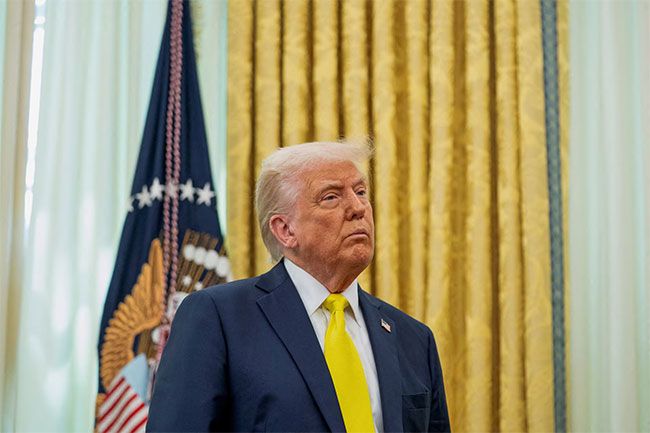
A presidential approval rating is a polling estimate of how many people say they approve of the president’s job performance at a given moment. It can shift when voters feel pressure in daily life, such as higher fuel bills, or when a crisis such as war changes perceptions of competence, priorities and risk. For investors, approval ratings are not a trading signal, but they can help explain the political backdrop for policy decisions, regulation and market sentiment.
What an approval rating actually measures
An approval rating is usually built around a simple question: do respondents approve or disapprove of the way the president is handling the job? The answer is often reported as a percentage, but it is not a precise head count of the nation. It is an estimate based on a sample of people, adjusted by the pollster to better reflect the broader population.
The most important point is that approval is broad. A person may approve of a president’s economic policy but disapprove of foreign policy, or like the president’s party but dislike a specific decision. That complexity is compressed into a single number, which is why issue-specific approval questions can tell a different story from overall job approval.
Approval ratings also depend on who is being surveyed. A poll of all adults can look different from a poll of registered voters or likely voters. Adults may give a broad reading of public mood, while likely-voter surveys are more useful near elections. Neither is automatically superior; each answers a different question.
How pollsters produce the number
Modern polling combines sampling, questionnaire design and statistical weighting. Pollsters contact a group of respondents, ask standardized questions, and then weight the responses so the sample better matches the population on factors such as age, gender, education, geography or party identification, depending on the poll’s method.
Polls may be conducted online, by phone, by text, through panels or by mixed methods. Each method has trade-offs. Online surveys can be fast and broad, while phone surveys may reach different groups of people. What matters is transparency: a useful poll explains who was surveyed, when, how, and how uncertain the estimate is.
When reading an approval poll, look for these basics:
- Population: adults, registered voters, likely voters or a party subgroup.
- Field period: the days during which interviews were conducted, especially important during fast-moving crises.
- Question wording: small wording differences can influence responses.
- Sample size and uncertainty: every poll has sampling error and other sources of error.
- Trend: movement across several polls is usually more meaningful than one survey.
A single poll can be useful, but a polling average or a consistent pattern across multiple reputable surveys is usually more informative. Even then, polling is an estimate of opinion, not a measurement as exact as a stock price or a bond yield.
Why crises can move public opinion
Crises concentrate attention. Many voters do not follow every policy debate, but they notice events that affect safety, prices, jobs or national identity. A foreign conflict, a major economic shock or a sudden disruption in energy markets can quickly change what people think the president is responsible for.
At the start of some international crises, leaders may receive a temporary boost as citizens rally around national institutions. That effect is not guaranteed, and it can fade if the public sees unclear goals, rising costs, poor communication or a widening conflict. Approval can also fall quickly when a crisis contradicts what voters believed a leader promised to do.
Domestic crises often affect approval through everyday experience. Inflation is powerful because it is visible and repetitive: people encounter it when they buy groceries, pay rent, fill a tank or renew insurance. Even if the causes are global or outside a president’s direct control, voters often judge leaders by whether life feels more affordable.
Why fuel prices matter so much politically
Fuel prices have an outsized role in political perception because they are public, frequent and easy to compare. A posted gasoline price is seen by drivers even when they are not buying fuel. For households that depend on cars, fuel costs feel immediate, unlike some economic indicators that are abstract or delayed.
Presidents do not control oil prices in a simple way. Energy prices can be affected by global supply and demand, refining capacity, shipping, inventories, taxes, currency moves, weather, conflict risk and producer decisions. Policy can matter, but it is only one part of a global system.
That distinction is important for readers and investors. Public opinion may punish or reward a president for fuel prices even when the underlying causes are complex. Markets, meanwhile, may react to the same energy shock through expectations for inflation, consumer spending, central bank policy, airline costs, industrial margins and energy-company earnings.
For example, higher fuel costs can squeeze households with less disposable income, while energy producers may benefit from higher commodity prices if costs and regulation do not offset the gains. Transport-heavy businesses may face pressure. The political reaction can then feed back into policy proposals such as tax relief, reserve releases, drilling rules, sanctions or subsidies.
How approval ratings matter to investors
Approval ratings rarely move markets by themselves. Investors should be cautious about treating a headline number as a reason to buy or sell. The market impact usually comes through second-order effects: what lower or higher approval means for policy choices, legislative leverage, election expectations and regulatory priorities.
Several channels are worth watching:
- Fiscal policy: leaders with political pressure may push tax cuts, spending measures or targeted relief.
- Regulation: sectors such as energy, banks, technology, healthcare and defense can be sensitive to political priorities.
- Trade and sanctions: foreign-policy approval can affect support for tariffs, export controls or sanctions.
- Defense and security spending: conflict can shift expectations for government procurement and budget debates.
- Consumer confidence: poor perceptions of the economy can influence spending behavior, though the link is not mechanical.
Investors should separate political noise from investable fundamentals. A president’s popularity may shape the environment, but company cash flows, balance sheets, valuation, competition and interest rates still matter. Political analysis is most useful when it helps identify risks that are not yet fully reflected in expectations.
Common mistakes when reading approval polls
The first mistake is treating approval as an election forecast. A president can have weak approval and still see the party perform well in some races, or have decent approval and face local or structural disadvantages. Elections depend on candidates, turnout, geography, the electoral system and the choices available to voters.
The second mistake is overreacting to one poll. Because every survey has uncertainty, small moves may be statistical noise. A change is more persuasive when it appears across multiple polls, persists over time, and fits with other evidence such as consumer sentiment, issue polling or election results.
The third mistake is ignoring question design. If respondents are asked about a policy with limited information, many may choose based on party identity or recent headlines. If the poll does not offer an unsure option, some people may select the closest available answer even when their views are weak.
The fourth mistake is assuming causation. If approval falls during a fuel-price spike or a foreign crisis, those events may be contributing factors, but they may not be the only reasons. Other issues, partisan polarization, media coverage and broader economic conditions can all interact.
Finally, investors should avoid building a portfolio around political approval alone. Polls can clarify the public mood, but they are not a substitute for diversification, risk management and analysis of the assets themselves.
Frequently asked questions
What is a good presidential approval rating?
There is no universal cutoff. Analysts usually compare a president’s rating with prior readings, with other polls, and with the political context. Direction and durability often matter more than a single level.
Can presidents directly control inflation or fuel prices?
No president has direct control over all prices. Policy can influence taxes, regulation, spending, trade and energy supply, but inflation and fuel prices also reflect global markets, central bank policy, supply chains and consumer demand.
Do wars always increase approval ratings?
No. Some crises may initially lift support if the public sees decisive leadership, but support can fall if costs rise, goals are unclear, or the conflict appears unnecessary. Public opinion during war is often volatile.
Should investors trade based on approval polls?
Approval polls should not be used as stand-alone trading signals. They are better treated as context for policy risk, election probabilities and public sentiment. This article is for information only and is not investment advice.
This article is for general information only and is not investment advice. Do your own research or consult a licensed adviser before making financial decisions.
Related articles
- Who Decides Place Names on Digital Maps?
- Heat Advisory: What It Means and How to Stay Safe
- How Sri Lanka’s Music Video Awards Work
Forrás: eredeti cikk