
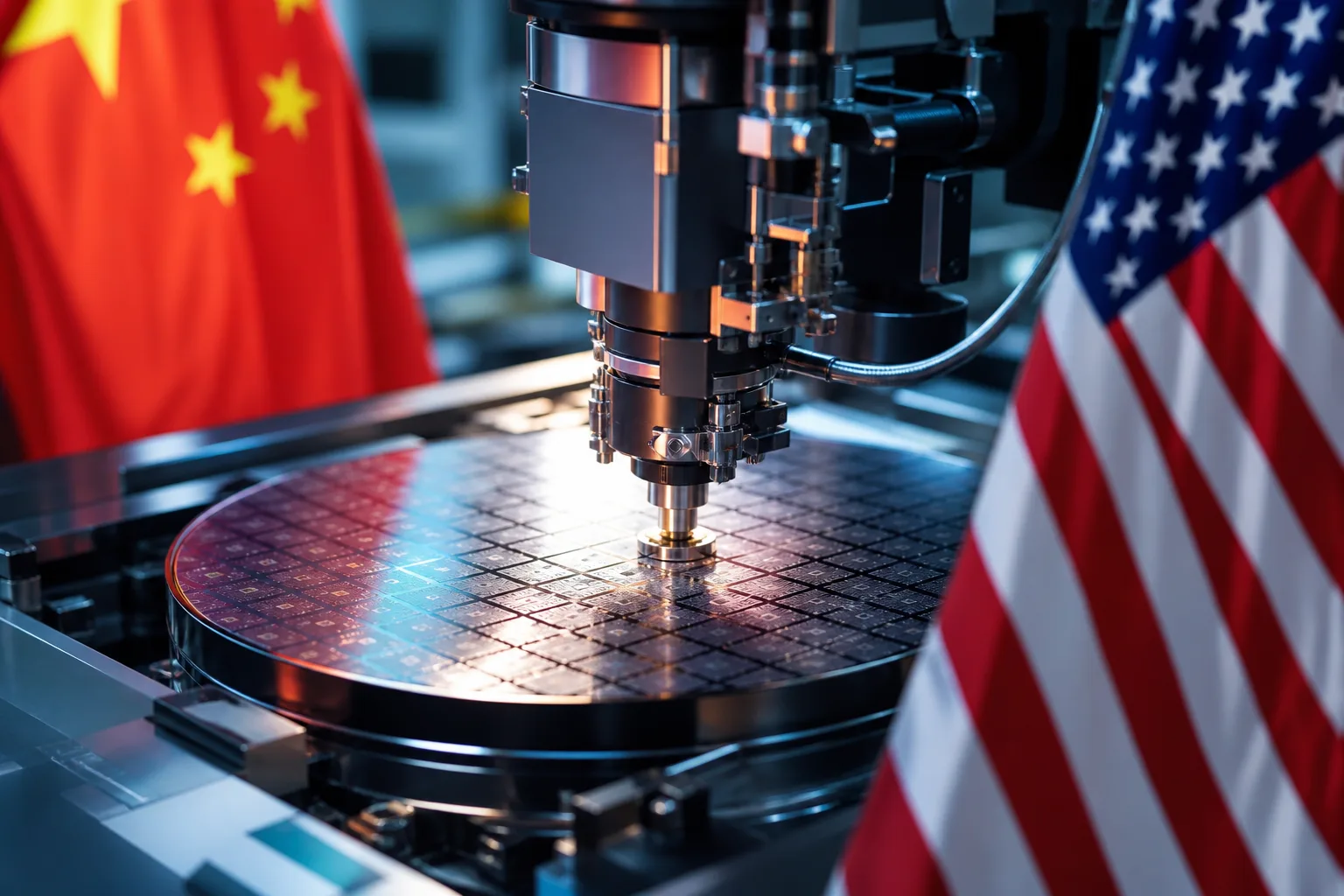
Semiconductor equipment stocks are once again being tested by the policy risk surrounding China, as investors weigh resilient chip demand against tighter export controls and a more fragmented global supply chain. The sector sits at the center of several major market themes: artificial intelligence, advanced manufacturing, national security policy and the long-running effort by China to reduce reliance on foreign technology.
For companies that sell the tools used to manufacture chips, the question is not simply whether AI demand remains strong. It is whether growth in leading-edge chipmaking can offset restrictions on sales to China, shifting customer spending plans and the risk of further regulatory tightening from the U.S. and allied governments.
Why chip equipment stocks are sensitive to China restrictions
Chip equipment stocks include companies that make lithography systems, deposition tools, etching equipment, inspection machines and other highly specialized products used inside semiconductor fabrication plants. Major global names in this area include Applied Materials, Lam Research, KLA, ASML and Tokyo Electron, among others.
These businesses are deeply tied to capital spending by chipmakers. When foundries, memory manufacturers and integrated device makers expand capacity or upgrade technology, they buy more equipment. When customers delay projects or face export limitations, equipment orders can soften quickly.
China has been an important end market for many equipment suppliers because domestic chipmakers have been investing heavily in local capacity. However, semiconductor export controls have limited the sale of certain advanced tools and technologies that could support cutting-edge logic chips, high-performance memory or AI-related computing capabilities.
That creates a difficult balancing act for investors. On one hand, restrictions may reduce revenue opportunities in China. On the other, government-backed chip investment in the U.S., Europe, Japan, South Korea and Taiwan could support demand outside China over time.
The AI chip supply chain is still a powerful tailwind
The strongest argument for semiconductor equipment stocks remains the long-term growth of the AI chip supply chain. Advanced AI systems require powerful processors, high-bandwidth memory, sophisticated packaging and leading-edge manufacturing processes. None of that is possible without increasingly complex equipment.
Demand for AI infrastructure has encouraged chipmakers to prioritize investments in advanced nodes, memory upgrades and packaging capacity. Equipment suppliers that serve these areas may benefit even if some China-related sales are constrained.
Key areas investors are watching include:
- Advanced logic manufacturing: AI accelerators and high-performance processors require cutting-edge production capabilities.
- Memory spending: AI servers depend on advanced memory, including high-bandwidth memory, which can require new process steps and additional equipment intensity.
- Inspection and metrology: As chips become more complex, customers need more precise tools to detect defects and improve yields.
- Advanced packaging: More AI chips rely on sophisticated packaging methods that connect processors, memory and other components efficiently.
This is why the market often treats equipment makers as strategic beneficiaries of AI, even though they do not always sell directly to cloud companies or end users. They enable the manufacturing capacity behind the AI boom.
What investors should watch in earnings commentary
For investors evaluating semiconductor equipment stocks, management commentary can be more important than headline results. Export rules can change, customer spending can shift and order timing can make quarterly performance uneven.
Several issues deserve close attention:
- China revenue exposure: Investors should look for how companies describe sales to China, including whether demand is coming from mature-node production or more restricted advanced applications.
- Backlog quality: A large backlog is useful only if customers are likely to proceed with deliveries and regulatory approvals remain intact.
- Customer mix: Spending by leading foundries, memory makers and logic manufacturers can signal where demand is strongest.
- Regulatory language: Any change in how companies discuss export controls may indicate rising compliance risk or new limitations.
- Service revenue: Maintenance, parts and support can provide more stable revenue than new tool sales, especially during cyclical slowdowns.
Investors should also avoid treating all chip equipment stocks as identical. A lithography supplier faces different risks from an etch provider, a metrology specialist or a company focused on wafer inspection. Exposure to China, advanced nodes and memory cycles varies meaningfully across the group.
China chip restrictions add uncertainty, not just downside
China chip restrictions are usually viewed as a negative for suppliers, but the impact is not always straightforward. Some restrictions apply mainly to advanced technologies, while sales of tools for less advanced production may still be allowed. China may also continue investing in mature-node capacity for automotive, industrial and consumer electronics applications.
At the same time, tighter rules can accelerate China’s push to develop domestic alternatives. That could eventually create more competition for global equipment leaders, especially in lower-end or less complex tool categories. However, the most advanced semiconductor manufacturing equipment remains extremely difficult to replicate, which helps protect established suppliers’ competitive positions.
Another factor is the response from non-China customers. The U.S. and allied countries have been encouraging local semiconductor production for strategic reasons. New fabs and supply-chain diversification may support long-term demand, although project timing can be slow and capital-intensive.
Bottom line for tech stocks and long-term investors
Semiconductor equipment stocks remain among the most important tech stocks to watch because they sit upstream from nearly every major chip trend. AI, cloud computing, electric vehicles, industrial automation and consumer electronics all depend on the manufacturing tools that make advanced semiconductors possible.
The China curbs test is real. Export controls can limit sales, create compliance complexity and pressure valuations when investors fear additional restrictions. But the sector also benefits from durable demand for advanced computing and from global efforts to expand semiconductor capacity.
For long-term investors, the key is to separate temporary policy-driven volatility from changes in competitive strength. Companies with broad customer bases, essential technology, strong service businesses and exposure to AI-related manufacturing may be better positioned to manage geopolitical disruption. In this environment, selectivity matters more than simply buying the broad chip equipment trade.