

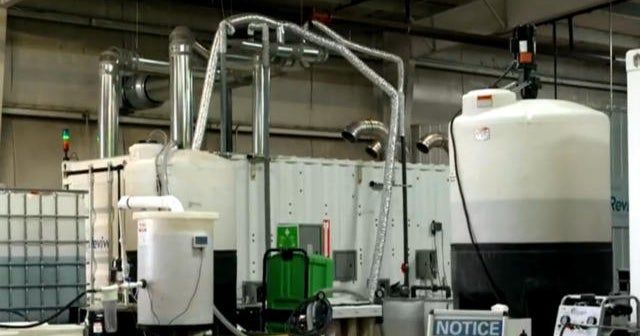
PFAS removal technology aims to deal with a difficult water problem: chemicals designed to resist heat, oil, water and breakdown can also resist ordinary treatment. The key distinction is that many systems capture PFAS from water, while newer technologies try to destroy them so the contamination is not simply moved somewhere else.
For households, utilities and investors, the subject matters because PFAS regulation, testing and cleanup are turning water treatment from a quiet infrastructure niche into a long-term technology market. But claims of instant elimination should be read carefully: the best solution depends on the specific PFAS, the water chemistry, the volume treated and what happens to the waste.
What are PFAS and why are they called forever chemicals?
PFAS stands for per- and polyfluoroalkyl substances, a large family of synthetic chemicals used for properties such as stain resistance, grease resistance, water repellency and heat tolerance. They have been used in products and industrial processes including nonstick coatings, firefighting foams, water-resistant textiles, food packaging, electronics manufacturing and metal plating.
The nickname forever chemicals comes from the strength of the carbon-fluorine bond found in many PFAS molecules. That bond helps make the chemicals useful in products, but it also makes many of them slow to degrade in the environment. Instead of breaking down quickly, PFAS can move through soil, groundwater, rivers and drinking water systems.
PFAS is not one chemical. Some well-known examples, such as PFOA and PFOS, have been heavily scrutinized and phased out of many uses in some markets. PFOA stands for perfluorooctanoic acid. Newer or shorter-chain PFAS may behave differently in water treatment systems, which is one reason blanket statements about removal can be misleading.
Why PFAS can persist in tap water
Tap water can contain PFAS when source water has been affected by industrial discharges, firefighting foam use, landfill leachate, wastewater releases or contaminated groundwater. Conventional drinking water treatment was designed mainly to remove pathogens, particles, organic matter and some chemical contaminants. It was not originally built around removing trace levels of highly persistent synthetic compounds.
Persistence also depends on mobility. Some PFAS dissolve readily in water and can travel long distances from the original source. Once they enter an aquifer or surface water body, cleanup can be technically difficult and expensive because the contamination may be diluted across large volumes of water while still being important at very low concentrations.
That is why PFAS treatment is often discussed in two separate settings. One is point-of-use treatment, such as an under-sink system for a home. The other is centralized treatment, where a utility treats water before distribution. The engineering, cost, maintenance and waste-disposal questions are very different in each case.
How proven PFAS removal technologies work
Most established PFAS water technologies do not destroy PFAS molecules. They separate them from water and concentrate them in a filter medium, resin, membrane reject stream or sludge. That can make water safer to use, but it creates a second problem: how to manage the PFAS-rich material afterward.
The main approaches include:
- Granular activated carbon: Water passes through carbon with a high surface area. Many PFAS molecules adsorb onto the carbon surface. It is a mature technology, but performance varies by PFAS type, water quality, contact time and how often the carbon is replaced or regenerated.
- Ion exchange resins: These engineered beads attract charged PFAS compounds. They can be effective for certain PFAS and may require smaller equipment footprints than carbon in some applications. Spent resin still needs careful handling.
- Reverse osmosis and nanofiltration: These membrane systems use pressure to separate water from many dissolved contaminants. They can be highly effective at the household scale and in specialized treatment settings, but they create a concentrated waste stream and use more pressure than simple filtration.
- Powdered activated carbon: This can be added during treatment processes and then removed with solids. It may be useful in some situations, though it is not always the most efficient option for all PFAS or all plants.
No filter should be treated as a permanent fix. Media can become exhausted, membranes can foul and performance can change as water chemistry changes. For consumers, certification, maintenance schedules and independent testing matter more than broad marketing language.
What emerging destruction technologies are trying to solve
The next frontier is PFAS destruction. If capture technologies are the first step, destruction technologies aim to break the strong chemical bonds and convert PFAS into less problematic end products. This matters because captured PFAS can otherwise end up in landfill, incineration systems, concentrated brines or other disposal pathways that may raise new concerns.
Several emerging approaches are being studied or deployed in limited settings:
- Supercritical water oxidation: Water is brought to extreme conditions where organic compounds can be oxidized rapidly. The promise is strong destruction potential for concentrated waste streams, but equipment complexity, energy use and materials durability are key questions.
- Electrochemical oxidation: Electric current and specialized electrodes are used to drive reactions that break down PFAS. It may be attractive for certain concentrated liquids, though electrode cost, energy demand and byproduct control are important.
- Plasma treatment: Electrical discharges create highly reactive conditions at the gas-water interface. This can attack PFAS in contaminated water or foam fractionates, but scaling and operating costs must be evaluated.
- Hydrothermal and alkaline processes: Heat, pressure and chemical conditions are combined to break PFAS apart. These methods are often discussed for concentrated wastes rather than ordinary tap water volumes.
- Foam fractionation followed by destruction: Some PFAS collect at air-water interfaces. Systems can concentrate them into a foam, reducing the volume that must then be destroyed by another technology.
When a company says its technology can eliminate PFAS within seconds, the right question is not only whether destruction occurs in a lab reactor. Investors, utilities and customers should ask what water matrix was tested, which PFAS were measured, what concentration was used, whether byproducts were tracked, how much energy was required and whether the system works continuously at real-world scale.
Why this matters to investors and technology watchers
PFAS treatment sits at the intersection of environmental regulation, municipal infrastructure, industrial liability and advanced materials. Water utilities may need to test, disclose and treat for specific PFAS. Industrial companies may need to manage legacy contamination or change processes. Consumers may buy home filtration products. Those forces can create demand for testing labs, filtration suppliers, engineering firms, membrane makers, resin producers and destruction-technology developers.
However, the market is not a simple gold rush. Water treatment is conservative for good reasons: systems must work reliably, safely and affordably over long periods. Municipal customers often move slowly, budgets can be political and technology claims must survive pilot testing, procurement reviews and regulatory scrutiny.
For investors, the useful lens is not just whether a technology sounds powerful. It is whether the company can solve a painful problem at a cost that customers can justify, with evidence that regulators, utilities and industrial buyers trust.
What to watch before trusting PFAS removal claims
PFAS claims can be confusing because words such as remove, reduce, eliminate, destroy and treat are sometimes used loosely. A careful reader should separate marketing from engineering evidence.
- Removal versus destruction: Does the system capture PFAS, or does it break the molecules down?
- Which PFAS were tested: Performance against one compound does not guarantee performance against the whole PFAS family.
- Independent verification: Look for third-party testing, certification or peer-reviewed data where available, not only company presentations.
- Real water conditions: Results in clean laboratory water may not match groundwater, landfill leachate, wastewater or tap water with competing contaminants.
- Waste handling: If PFAS is captured, where does the spent carbon, resin, membrane concentrate or sludge go?
- Total cost: Equipment price is only one part. Energy, replacement media, labor, downtime, monitoring and disposal can dominate lifecycle cost.
For household filters, buyers should avoid assuming that any carbon pitcher, refrigerator filter or generic purifier removes PFAS. Product certifications and contaminant-specific performance claims are important, and filters must be replaced on schedule.
Frequently asked questions
What are the risks of PFAS in drinking water?
Health concerns vary by compound and exposure level, but regulators and scientists have focused on links between certain PFAS and effects involving the immune system, cholesterol, liver function, development and some cancers. The practical point for households is to rely on official water testing, local advisories and certified treatment options rather than guessing from taste or appearance, because PFAS usually cannot be detected by the senses.
What does PFOA stand for?
PFOA stands for perfluorooctanoic acid. It is one of the best-known PFAS chemicals and has been widely studied because of its persistence, mobility and health concerns. It is only one member of a much larger PFAS family.
What brands of water have PFAS?
PFAS findings can vary by source, treatment, location and testing date, so a fixed brand list can become misleading. For bottled water or home water products, look for recent testing disclosures, contaminant-specific certifications and clear information about the water source and treatment method.
What is the EPA’s stance on PFAS chemicals?
The U.S. Environmental Protection Agency treats certain PFAS as serious drinking water and environmental contaminants and has moved toward enforceable limits, monitoring and cleanup actions for selected compounds. Its approach reflects the view that exposure should be reduced, especially where PFAS is found in public water systems or contaminated sites.
This article is for general information only and is not investment advice. Do your own research or consult a licensed adviser before making financial decisions.
Related articles
- How to Avoid Traveler’s Tummy on Vacation
- Developmental Disabilities in Children, Explained
- How to Manage Summer Stress and Anxiety
Forrás: eredeti cikk