
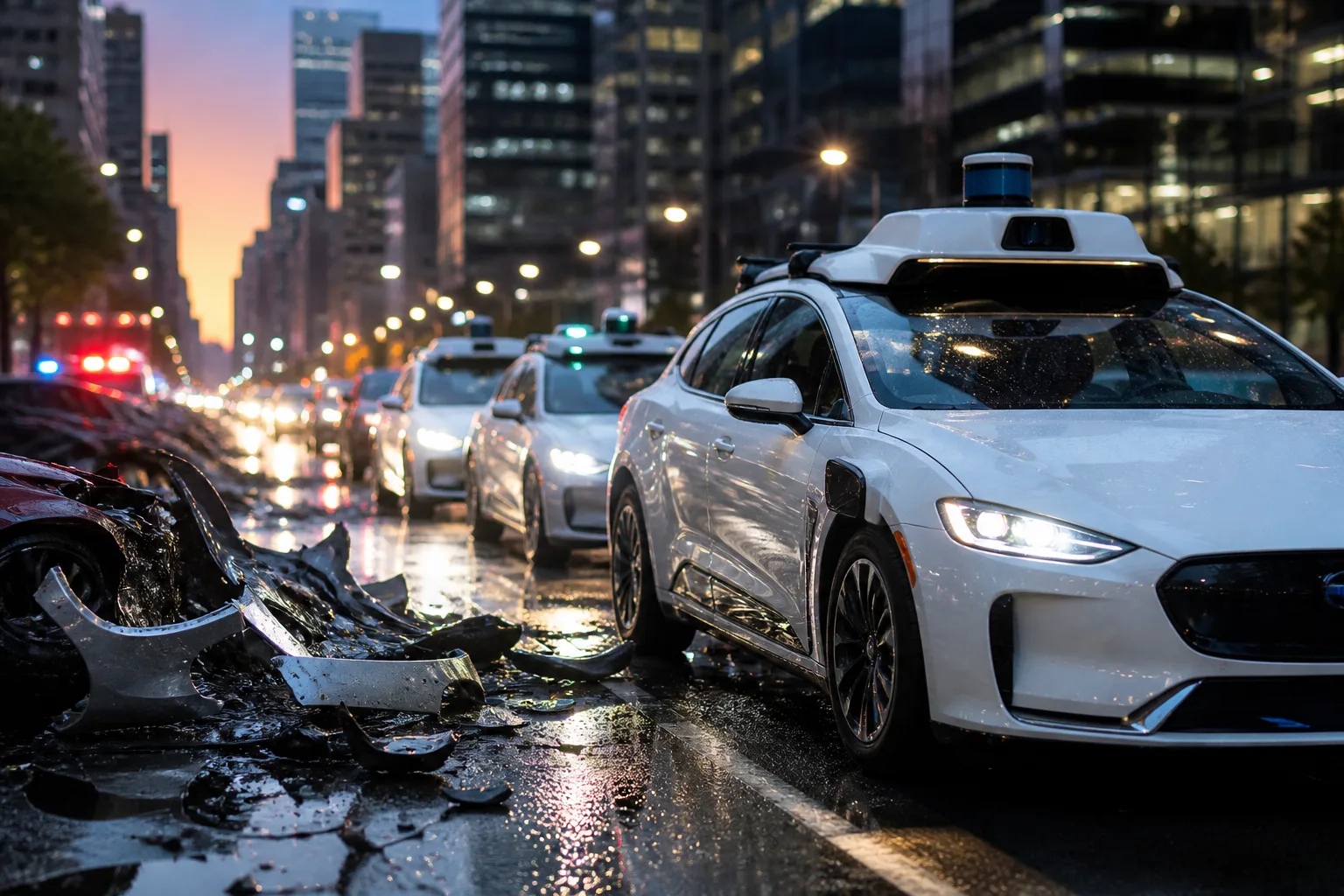
For investors, robotaxi stocks have long offered a compelling story: software-driven vehicles, lower labor costs, and a future mobility network that could scale like a technology platform rather than a traditional car business. But the road to commercialization is not only about sensors, artificial intelligence, and fleet operations. A less glamorous issue is moving to the center of the investment case: liability.
As self-driving cars move from controlled pilots to real streets with paying passengers, the question of who pays when something goes wrong becomes more important. That uncertainty affects valuations across autonomous vehicle stocks, from companies building full robotaxi networks to automakers, suppliers, insurers, and mapping or AI infrastructure providers tied to the sector.
Why liability is becoming a market issue
In a conventional crash, responsibility typically centers on the driver, the vehicle owner, insurers, and sometimes manufacturers if a defect is involved. Robotaxis complicate that framework. If there is no human driver, responsibility may shift toward the company operating the vehicle, the developer of the autonomous driving system, the automaker, software vendors, maintenance providers, or some combination of those parties.
That matters because investors are not only valuing future revenue. They are also trying to estimate future costs. A robotaxi network may generate recurring fares, but it may also carry exposure to litigation, insurance claims, vehicle downtime, regulatory investigations, and reputational damage after high-profile incidents.
The challenge is that the industry still lacks a long operating history at broad scale. Without that track record, it is harder for insurers, regulators, and investors to model risk with confidence. Even if autonomous systems eventually prove safer than human drivers in many conditions, markets tend to discount uncertainty before they reward potential.
Tesla robotaxi ambitions meet a different kind of scrutiny
Tesla remains central to the robotaxi debate because of its brand, large vehicle fleet, AI ambitions, and repeated statements about autonomous mobility. A Tesla robotaxi platform, if successfully deployed, could change how investors view the company: less like a cyclical automaker and more like a mobility and software platform.
However, liability questions are especially important in Tesla’s case because the company’s approach depends heavily on AI, onboard cameras, and software improvement over time. Investors will be watching not just whether the technology works in demonstrations, but how it performs under real-world conditions: bad weather, unusual road layouts, aggressive human drivers, construction zones, emergency vehicles, and passenger behavior.
For the stock market, the key question is not whether a robotaxi vision is exciting. It is whether the eventual business model can absorb insurance costs, legal exposure, vehicle maintenance, customer support, and regulatory compliance while still producing attractive margins.
Waymo shows progress, but also the limits of scaling
Waymo is often viewed as one of the most advanced players in autonomous ride-hailing. Its service in select markets has helped prove that driverless passenger trips are no longer science fiction. For investors in AI mobility, that is an important milestone.
Still, Waymo’s progress also highlights the practical constraints of the business. Robotaxi deployment requires detailed mapping, operational oversight, remote assistance capabilities, fleet cleaning and charging, local regulatory engagement, and a safety case that can withstand public and political scrutiny. Those requirements can make expansion slower and more expensive than a typical app-based marketplace.
Liability risk fits into that same scaling problem. Each new market brings different roads, weather patterns, driving cultures, insurance rules, and legal environments. A company that operates safely in one city may still need extensive validation before launching in another. That can affect the pace at which revenue grows, which in turn affects how investors value related autonomous vehicle stocks.
How auto insurance risk could reshape the sector
Auto insurance risk is one of the least flashy but most important variables for robotaxi stocks. If insurers view autonomous fleets as difficult to price, coverage could become expensive or restrictive. If robotaxi operators choose to retain more risk themselves, they may need stronger balance sheets and larger reserves for claims.
Several factors could influence insurance and liability costs:
- Incident frequency: How often autonomous vehicles are involved in crashes, even minor ones.
- Incident severity: Whether claims involve property damage, injuries, service interruption, or broader legal disputes.
- Data transparency: Whether operators can provide clear, reliable driving data to insurers, regulators, and courts.
- Human oversight: The role of remote operators, fleet supervisors, and maintenance teams in preventing or responding to incidents.
- Regulatory standards: How local and national authorities define safety requirements for driverless vehicles.
- Public trust: Whether consumers and city officials remain comfortable with deployment after highly publicized failures.
For investors, the issue is not simply whether robotaxis can be insured. It is whether insurance and liability costs allow the business to scale profitably.
What investors should watch in robotaxi stocks
Because the robotaxi market is still developing, investors may want to look beyond promotional timelines and focus on operational evidence. The strongest companies will likely be those that can show disciplined deployment, transparent safety reporting, constructive regulator relationships, and a credible plan for managing claims and insurance costs.
Key signals to monitor
- Expansion pace: Rapid growth can be positive, but only if safety performance and service quality hold up.
- Regulatory tone: Supportive regulators can accelerate deployment, while investigations or permit restrictions can slow it.
- Partnerships: Deals with automakers, insurers, logistics firms, or cities may reduce operational friction.
- Unit economics: Investors should look for evidence that revenue per vehicle can exceed operating, insurance, and support costs over time.
- Balance sheet strength: Companies with more financial flexibility may be better positioned to handle setbacks.
The liability roadblock does not mean robotaxis are doomed. It does mean the market may need to treat self-driving cars less like a pure software story and more like a high-stakes transportation business. AI mobility could still become a major long-term theme, but the winners will need more than impressive technology. They will need trust, regulatory durability, and a financial model that accounts for what happens when autonomy meets real-world risk.