
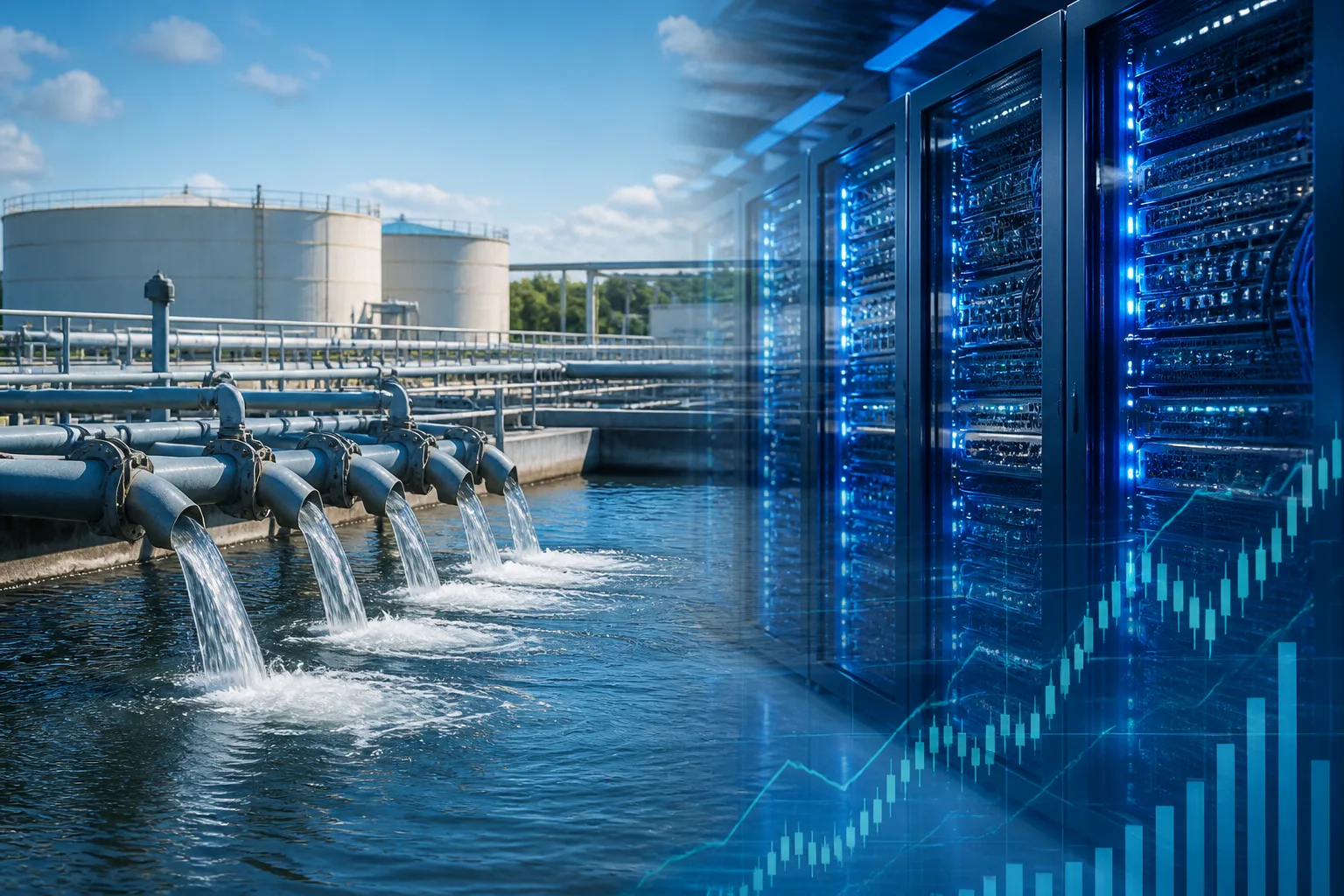
Water stocks are getting a fresh look from investors as the buildout of AI data centers intensifies demand for power, land, grid equipment and cooling capacity. For years, the “AI trade” has centered on chipmakers, cloud platforms and select tech stocks. Now the market is widening its lens to the less glamorous infrastructure behind artificial intelligence, including the water systems that help keep high-performance computing facilities operating safely and efficiently.
This does not mean every water utility or equipment supplier is suddenly an AI winner. Water is highly local, heavily regulated and politically sensitive. But the connection between AI data centers and water use is real enough that investors are beginning to evaluate which companies may benefit from long-term spending on water infrastructure, treatment, monitoring and efficiency.
Why AI Data Centers Bring Water Into the Investment Conversation
AI data centers run dense clusters of servers that generate substantial heat. Operators use a range of cooling methods, including air cooling, liquid cooling and evaporative systems. The exact water footprint depends on climate, facility design, local regulations, energy source and cooling technology. In some regions, operators may rely more heavily on water-based cooling because it can be effective and energy-efficient. In others, limited water availability or public opposition may push companies toward closed-loop or lower-water approaches.
That creates a complicated but investable theme: AI growth may not simply increase water consumption; it may increase demand for smarter water management. Data center developers need permits, reliable supply, wastewater handling, monitoring systems and sometimes advanced treatment or reuse solutions. Municipalities also need to balance economic development with residential, agricultural and environmental demands.
For investors, this makes the water angle different from a straightforward commodity trade. Water itself is not traded like oil or copper in most public markets. The opportunity is more often found in utility stocks, engineering firms, pump and valve makers, filtration companies, testing equipment providers and infrastructure contractors.
Where Water Stocks Fit in the AI Cooling Trade
The term “water stocks” can cover several types of businesses. Some are regulated utilities that provide drinking water and wastewater services. Others sell products or services used in industrial and municipal water systems. A few diversified industrial companies have water-related divisions that may be only one part of a larger business.
1. Regulated water utilities
Water utilities tend to appeal to investors seeking stability rather than rapid growth. Their revenue is often tied to regulated rate structures and long-lived assets. If a service territory attracts more industrial demand, including data centers, that may support infrastructure investment over time. However, utilities usually need regulatory approval to recover spending, and customer affordability remains a key political issue.
2. Water technology and equipment suppliers
Companies that make pumps, valves, filtration systems, sensors, leak detection tools and treatment equipment may be more directly exposed to capital spending. AI data centers require reliable cooling infrastructure, and industrial users increasingly want systems that reduce waste, recycle water or improve operational visibility. These companies may also benefit from broader trends such as aging municipal infrastructure and stricter water quality requirements.
3. Engineering and infrastructure firms
Large-scale development often requires design, permitting, construction and maintenance expertise. Firms involved in infrastructure investing themes may gain from projects that upgrade water supply, wastewater capacity, stormwater systems or industrial treatment facilities. Their exposure to AI data centers may be indirect, but data center growth can add urgency to local infrastructure planning.
What Investors Should Watch Before Buying the Theme
The AI cooling trade can be attractive, but it is not risk-free. Investors should avoid assuming that every water-related company will benefit equally. A careful review should include the following factors:
- Geographic exposure: Water stress varies widely by region. A utility in a fast-growing data center market may face opportunity, but also greater scrutiny over supply and conservation.
- Regulatory environment: Utilities depend on regulators for rate recovery. Even necessary infrastructure spending can become contentious if bills rise too quickly.
- Customer concentration: Industrial contracts can be valuable, but reliance on a few large customers may add risk if projects are delayed or canceled.
- Technology mix: Some data centers may shift toward cooling designs that use less water. That could favor efficiency and equipment suppliers over simple volume-based assumptions.
- Balance sheet strength: Water infrastructure is capital-intensive. Companies with high debt or rising financing costs may have less flexibility.
- Valuation: A good theme can still be a poor investment if expectations are already too high.
How This Theme Compares With Traditional Tech Stocks
Compared with semiconductor or cloud computing names, water stocks are usually less explosive. They are not likely to match the revenue growth profile of leading AI chip designers. But they may offer a different role in a portfolio: exposure to the physical infrastructure that supports digital growth.
This is why the water theme overlaps with both utility stocks and infrastructure investing. It may appeal to investors who want to participate in AI-related capital spending without relying entirely on high-multiple tech stocks. In practice, the best approach may be to separate “AI beneficiaries” into layers: chips and software at the top, power and cooling in the middle, and regulated infrastructure at the base.
That said, investors should be cautious about marketing narratives. If a company mentions AI data centers on an earnings call, that does not automatically make it a pure-play AI infrastructure stock. The key questions are whether the company has measurable exposure, pricing power, project backlog, technical expertise and a reasonable path to returns on invested capital.
The Bottom Line for Water Stocks
AI is reshaping more than the technology sector. As data centers expand, they are putting new attention on power grids, land use, permitting and water systems. That makes water stocks a logical part of the broader AI infrastructure discussion, especially for investors looking beyond the most crowded tech trades.
The strongest opportunities may come from companies that help customers use water more efficiently, improve reliability or expand essential infrastructure in high-growth regions. But the theme requires selectivity. Water is local, regulated and often politically sensitive, so investors should look for durable demand rather than short-term hype.
In a market where AI enthusiasm can move quickly from one sector to another, water stocks offer a more grounded angle: the practical systems needed to keep the digital economy running. For long-term investors, that may be the real appeal of the AI cooling trade.