

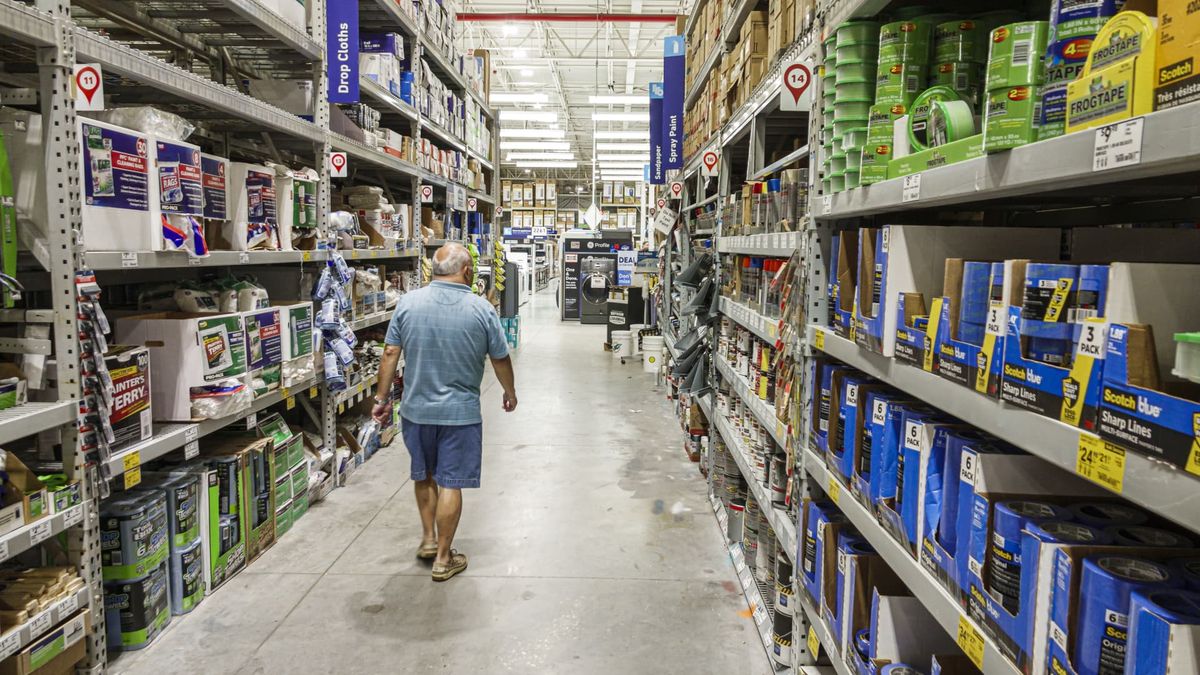
Jeff Greenberg | Universal Images Group | Getty Images
Inflation has eased gradually across the broad U.S. economy, and some areas of consumer spending, such as furniture and gasoline, have even deflated over the past year.
Deflation is when prices decline for goods and services.
It is rare for prices to fall from their current levels across the economy at large, economists said.
However, prices for many physical goods have deflated as supply-and-demand dynamics return to normal following pandemic-era contortions.
“Outside of goods prices, I don’t think we’ll see price cuts,” said Mark Zandi, chief economist at Moody’s.
“[Businesses] will hold the line on price if demand is soft but outright price declines are very rare, and even in a recession are not common,” Zandi said.
Additionally, prices for energy and food commodities can be volatile, so it is not unusual to see swings up and down. Consumer electronics also continually improve in quality, a dynamic that statisticians equate to deflation but which may only be apparent on paper and not at the store.
Which goods prices have deflated
Average prices for “core” goods — commodities that exclude food and energy — have deflated about 1% since September 2023, according to the consumer price index.
Demand for physical goods soared in the early days of the Covid-19 pandemic. Consumers were confined to their homes and could not spend on things such as concerts, travel or dining out. Households also had more discretionary income, as they pulled back on spending and had more cash from federal aid.
The pandemic also snarled global supply chains, meaning goods were not hitting the shelves as quickly as consumers wanted them.
Such supply-and-demand dynamics drove up prices.
Now, those contortions have largely eased and prices have declined as a result, economists said.
For example, prices for household furnishings have fallen about 2% over the past 12 months, as have those for appliances (down 3%), tools and hardware (4%), women’s outerwear (6%) and sporting goods (2%), according to CPI data.
More from Personal Finance:
Ozempic is driving up the cost of your health care
Here’s why the Social Security COLA is smaller for 2025
Here’s the inflation breakdown for September 2024
Vehicles have also “been one of the key areas of goods deflation,” said Sarah House, senior economist at Wells Fargo Economics.
New and used vehicle prices have deflated 1% and 5%, respectively, since September 2023.
It is natural to see some “give back” in price since vehicles saw among the largest spikes when inflation began to pop in 2021, House said. In June 2021, for example, used car prices were up 45% from a year earlier.

The U.S. Federal Reserve also raised interest rates aggressively to combat high inflation, leading to pricier financing costs for car buyers. That served to weaken demand, which also pushed down prices, economists said. The Fed began an interest rate-cutting cycle in September.
Outside of supply-demand dynamics, the U.S. dollar’s strength relative to other global currencies has also helped rein in prices for imported goods, economists said. This makes it less expensive for U.S. companies to import items from overseas, since the dollar can buy more.
Energy, food and consumer electronics
Outside of imported goods, consumers may also see a “normalization” of prices in food and energy, Zandi said. They are influenced by “big swings in commodity prices, the value of currencies and trading relationships,” he said.
For example, regular unleaded gasoline prices have declined about 16% since September 2023, according to CPI data.
Food prices are also generally underpinned by their own unique supply-and-demand dynamics. Categories such as apples, potatoes, frozen vegetables and fresh fish and seafood have seen prices deflate about 11%, 4%, 2% and 1%, respectively.
The quality of consumer electronics such as televisions, cell phones and computers also continually improves, meaning consumers generally get more for the same amount of money. The U.S. Bureau of Labor Statistics, which compiles the monthly CPI report, equates that to a price decline in the inflation data.
Forrás: eredeti cikk