
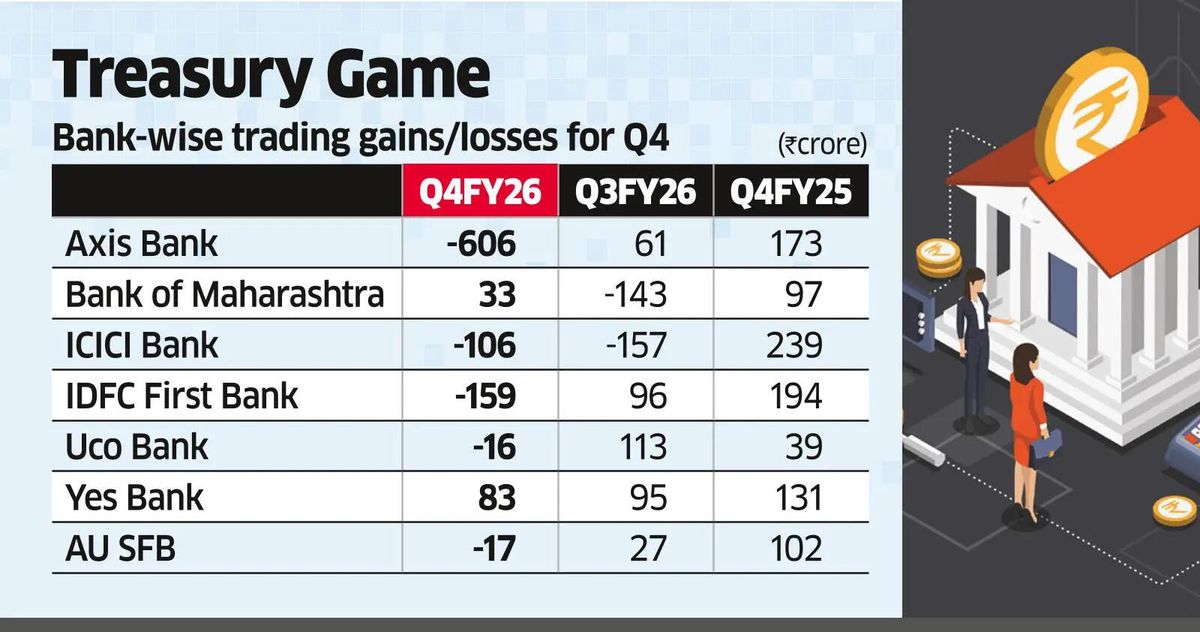
Five lenders, including private sector player Axis Bank, AU Small Finance Bank and state-owned UCO Bank, suffered treasury losses while a few others reported a dip in income as compared to the year-ago period. Ten banks announced their quarterly results so far.
“Trading losses are mainly due to interest rates rising in the last quarter. Also, the forex book corrections at margin could have affected treasury gains,” Bank of Baroda chief economist Madan Sabnavis said, adding that he expects a stable income from treasury in the first quarter of this fiscal.
Rising interest rates drove bond prices lower and yields higher, inflicting mark-to-market losses while the central bank mandated caps on banks’ net open positions in the foreign exchange market and curbs on forex derivatives impacted banks’ treasury income, said people familiar with the matter. The Reserve Bank of India (RBI) rejected requests to amortise mark-to-market treasury losses, compelling commercial banks to make full recognition in the fourth quarter.
 Agencies
Double whammy Rising rates lowered bond prices causing mark-to-market losses; curbs on derivatives hit treasury gains
Axis Bank suffered the heaviest trading loss of ₹606 crore in the January-March period, while ICICI Bank and IDFC First Bank booked a loss of ₹106 crore and ₹159 crore, respectively. UCO Bank reported a ₹16 crore treasury loss.

Axis and Uco reported a dip in their respective operating profit.
Meanwhile, experts expect a near-term deceleration in loan growth as lenders have turned cautious, shifting focus towards portfolio protection rather than balance sheet expansion.”There is no material impact of the geopolitical conflict so far on our business. That said, we remain cautious across customer segments,” said RBL Bank managing director R Subramaniakumar.
Axis Bank also took a hit on its profitability with a voluntary one-time provision of ₹2,001 crore on standard assets to cushion any possible credit risks on account of the Iran war.
The major sectors impacted by the war are fertilisers, steel and petroleum-based products, while early signs of deceleration are also visible in select indicators such as port cargo and air passenger traffic, said the RBI’s state of the economy report.
Business optimism fell to a five month low in March, one of its weakest levels since the Covid-19 pandemic, the RBI said.
“Credit growth will be in the range of 12-14%. Base effects along with caution on investments by large units in manufacturing will keep growth slower than last year,” Sabnavis said.
Bank credit grew 16.08% in 2025-26, RBI data showed.
Forrás: eredeti cikk