
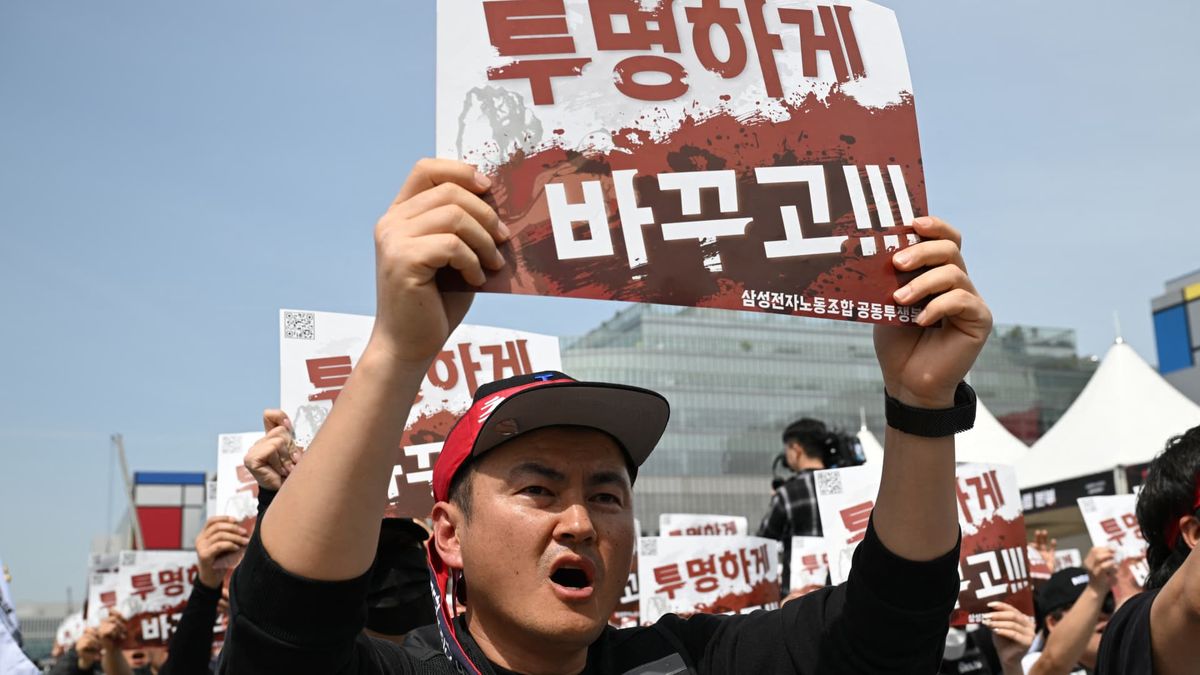
Members of the Samsung Electronics labour union hold signs reading “Change it to be transparent!” as they stage a mass rally demanding the removal of a cap on performance bonuses, outside the company’s foundry and semiconductor factory in Pyeongtaek on April 23, 2026. (Photo by Jung Yeon-je / AFP via Getty Images)
Jung Yeon-je | Afp | Getty Images
South Korean President Lee Jae Myung on Monday called for both labor and management rights to be respected as an 18-day strike at Samsung Electronics looms.
Lee, posting on X in Korean, said “labor must be respected as much as business, and corporate management rights must be respected as much as labor rights.”
“Excess is not beneficial; extremes lead to reversal,” he added, according to a CNBC translation of his statement.
Lee’s remarks are the latest in a chorus of statements from government officials urging Samsung Electronics and its workers’ union to reach an agreement before a planned strike set to begin on May 21.
A final round of talks between the union and Samsung’s management was scheduled for Monday.
The union’s demands center on Samsung’s performance-based bonus system. It is seeking performance bonuses equivalent to 15% of Samsung’s operating profit, the removal of bonus payout caps, and a formalized bonus structure, among other measures.
Samsung’s management has offered to allocate 10% of operating profit to bonuses and provide a one-time special compensation package, according to South Korean news agency Yonhap.
Shares of Samsung Electronics jumped as much as 6.65% on Monday before paring gains to around 3%.
Economic fallout
On Sunday, South Korean Prime Minister Kim Min-seok reportedly said that the government would explore all possible response measures, including “emergency adjustments,” if the strike risks causing “significant damage.”
Under South Korean law, the labor minister can invoke an “emergency adjustment” to suspend industrial action for 30 days if a dispute is deemed likely to harm the economy or daily life.
Kim described Monday’s negotiations as the final opportunity to avert the strike, adding that “the economic losses we will face will be beyond imagination.”
The prime minister estimated that the direct losses from the strike could reach 1 trillion won ($664.7 million). The economic loss could rise to as much as 100 trillion won if chip production disruptions force Samsung to scrap semiconductor wafers already in production.
However, Samsung’s workers’ union disputed the impact of the strikes, saying in a statement that previous production pauses had occurred for equipment inspection, maintenance and process adjustments.
It also stated that the government did not adequately review the union’s rebuttal materials and focused solely on management claims.
Samsung Electronics accounts for 22.8% of South Korea’s exports and 26% of its total market capitalization, he highlighted. Seoul’s presidential office also said Samsung Electronics revenue accounts for 12.5% of South Korea’s GDP.
Analysts have raised concerns about concentration risks in South Korea’s stock market, with an overreliance on a small group of companies raising the risk of volatility and vulnerability to geopolitical shocks, including a slowdown in data-center spending.

Kim’s statements also followed an X post by Finance Minister Koo Yun Cheol last week, warning that “strikes must never happen under any circumstances.”
“Samsung Electronics is an important company that the world is watching,” Koo wrote. “Considering the current management situation and its impact on the national economy, both labor and management sides must continue to strive to achieve principled negotiations.”
Samsung chairman Lee Jae-yong on Saturday issued a rare public apology to customers worldwide for causing “worry and anxiety,” according to South Korean media reports.
More than 47,000 workers could participate in the strike, the union said.
It also said a rally on April 23, which drew 40,000 workers, led to a 58% drop in foundry production and an 18% decline in Samsung’s memory production that day. The union estimated an 18-day strike could cost Samsung about 30 trillion won, or about $20 billion.
— CNBC’s Miko Jang contributed to this report.
Forrás: eredeti cikk