


Intel has spent the last few years trying to reinvent itself and prove it’s still relevant in an AI-centric world dominated by Nvidia’s chips.
On Thursday, as Intel crushed Wall Street financial targets, the company had a new message: There’s nothing wrong with being a 58-year-old maker of PC and server microprocessors.
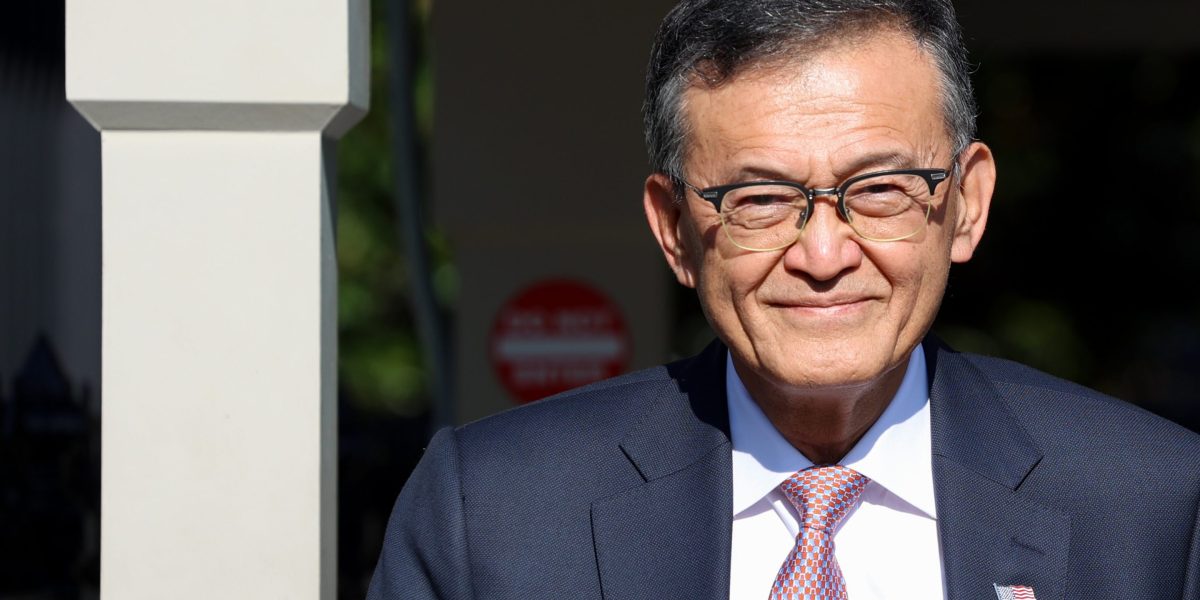
“We are embracing our roots as data driven, paranoid, and engineering driven,” CEO Lip Bu Tan said at the start of the company’s Q1 earnings conference call, referencing the famous “only the paranoid survive” philosophy of Andy Grove, the late cofounder of Intel.
Shares of Intel surged more than 22% in after hours trading Thursday after the company reported first-quarter results. Instead of the 2% decrease in revenue that analysts were expecting for the first three months of the year, Intel grew revenue 7% year-over-year to $13.6 billion. Revenue in the current quarter will range between $13.8 billion and $14.8 billion, Intel said, well above the $13.06 billion analysts have been expecting.
Demand for Intel’s central processing units (CPU) chips, which are based on its longstanding x86 architecture, is booming, the company said. In fact, revenue would have been even higher had it been able to produce more of the chips.
“A year ago the conversation around Intel was about whether we could survive,” Tan said. “Today it’s about how quickly we can add manufacturing capacity and scale our supply to meet enormous demand for our products.”
It was hardly an exaggeration when it comes to the bleak outlook for the company, which he joined as CEO in March 2025, a few months after Pat Gelsinger was ousted from the top job. At the time, many observers, including former board members, wondered whether the company should be broken apart, with its manufacturing facilities sold or spun into a separate business. A few months after Tan started, the U.S. government bought a 10% stake in Intel, helping to shore up the company in a deal the Trump administration said was important for national security and American industry.
CPUs are back, but is Intel?
The resurgence in demand for Intel’s CPUs is a somewhat surprising turn of events after several years in which the GPUs, or graphics processing units, made by Nvidia appeared to be the future because of their prowess with AI models.
“In recent months we have seen clear signs that the CPU is reasserting itself as the indispensable foundation of the AI era,” Tan said on the call. The reason, he explained, is that CPUs are better suited for running AI services, as opposed to creating—or training—AI models, where GPUs have the edge. In the early days of the generative AI boom, as companies like OpenAI, Anthropic, and Google were training giant new AI models, GPUs were the clear winner. But as the market evolves, Intel said the pendulum is swinging back to CPUs.
Intel finance chief Dave Zinsner said that the ratio of GPUs to CPUs in AI data centers is changing. While there are typically seven or eight GPUs for every one CPU for the job of training AI models, the ratio is only three or four GPUs for every one CPU when it comes to inference, or running AI models. And as agentic AI gains ground, Zinsner said the ratio could hit parity or even flip in Intel’s favor.
But there are still plenty of challenges. Nvidia recently released its first standalone CPU, adding to existing competition Intel faces from longtime rival AMD, as well as from server chips based on the ARM architecture (including an upcoming chip that ARM is making itself, instead of strictly licensing the chip design to other companies).
And the bigger question is whether Intel’s resurgence is truly a sign that the company is on the mend, or simply a reflection of the booming AI infrastructure buildout, as data center companies snap up as many chips as they can. Big questions also remain about Intel’s so-called foundry business, which manufactures chips for other companies and competes with global giant TSMC—particularly whether Intel will continue to invest the massive sums required to develop the next generation of chipmaking technology.
Tan has previously said Intel would not commit to building factories using the most advanced 14A fabrication process (capable of producing chips with 1.4 nanometer circuits) unless it has committed customers. And he gave no update on that front on Thursday, despite speculation that Elon Musk and Telsa’s recently announced partnership with Intel, via Terafab, might be the much-anticipated 14A customer.
Asked about Terafab deal, Tan described it as a broad relationship in which the two companies will learn a lot together, but provided few specifics. “Elon and I believe the global supply chain is not keeping pace with the rapid acceleration in the demand,” he said.
As for 14a customers, Tan was equally tight lipped: “We’re making great progress in terms of yield and cycle time. And clearly we’re engaging with multiple customers; heavy engaging. My style is underpromise, over delivering. So we have no plans to announce the customer unless a customer wants to announce it.”
Forrás: eredeti cikk