

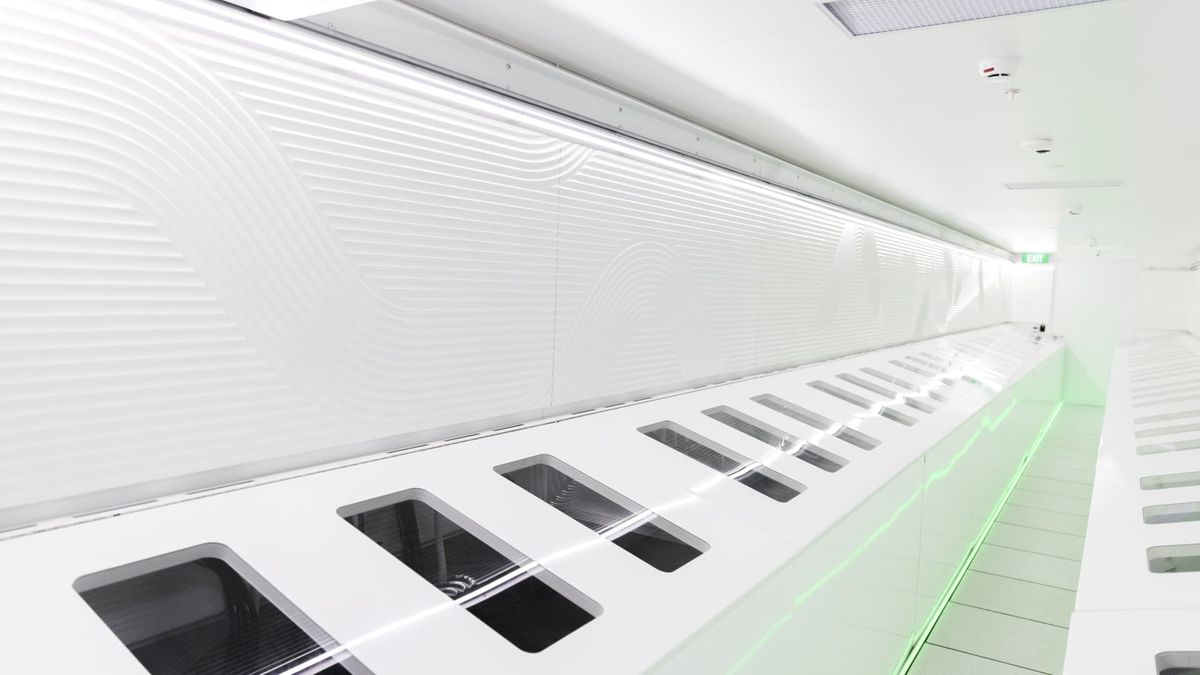
Immersion cooling is a data center cooling method that places servers in a non-conductive liquid so heat can be pulled away from chips more efficiently than with moving air alone. It matters because AI servers pack power-hungry GPUs into dense racks, making traditional cooling harder and sometimes more expensive. Claims of large energy savings can be plausible in specific facilities, but investors should treat any headline percentage as dependent on design, climate, workload and what is being compared.
What immersion cooling is
In a conventional data center, servers sit in racks and are cooled by air. Fans inside the servers move heat away from processors and memory, while room-level systems supply chilled or conditioned air through aisles, ducts or underfloor spaces. That approach is familiar, serviceable and widely deployed, but it becomes more difficult as each rack consumes more power and creates more heat.
Immersion cooling changes the basic heat-transfer method. Instead of relying mainly on air, server hardware is placed in a bath or sealed enclosure filled with a dielectric fluid. “Dielectric” means the fluid does not conduct electricity under normal operating conditions, so electronic components can be submerged without short-circuiting.
The liquid absorbs heat directly from chips, circuit boards and other components. The warmed liquid is then circulated through a heat exchanger, where the heat is transferred to another loop and ultimately rejected outside the building or reused elsewhere. Because liquids carry heat more effectively than air, immersion systems can support higher rack densities with less dependence on high-speed fans and large volumes of chilled air.
How immersion cooling works
There are two main categories: single-phase and two-phase immersion cooling. In single-phase systems, the coolant remains liquid while it absorbs heat. Pumps or natural convection move the warm fluid to a heat exchanger, and the cooled fluid returns to the tank or enclosure. These systems often use synthetic hydrocarbons, mineral-oil-like fluids or other engineered coolants designed for electronics.
In two-phase systems, the coolant boils at a low temperature when it contacts hot components. The vapor rises, condenses on a cooler surface and drips back into the bath. This can be very efficient at moving heat, but it also raises questions about fluid cost, containment, maintenance practices and environmental handling depending on the chemistry used.
A typical immersion-cooled setup includes several parts:
- Immersion tank or enclosure: The physical container that holds servers and cooling fluid.
- Dielectric fluid: The non-conductive coolant that contacts the hardware.
- Heat exchanger: Equipment that transfers heat from the immersion loop to a facility water loop or another cooling system.
- Pumps, sensors and controls: Systems that manage flow, temperature, leaks and alarms.
- Modified or validated servers: Hardware that is compatible with the fluid, service procedures and warranty terms.
Immersion cooling is part of a broader shift toward liquid cooling in data centers. Another major approach is direct-to-chip cooling, where cold plates are attached to processors and liquid runs through those plates. Immersion cools more of the server, while direct-to-chip focuses on the hottest components. Many operators may use a mix of air cooling, direct liquid cooling and immersion rather than choosing one method for every workload.
Why AI data centers are interested
AI training and inference can require dense clusters of GPUs or other accelerators connected by high-speed networking. These systems produce substantial heat in a small footprint. If a facility cannot cool a rack safely, it may have to spread equipment across more floor space, reduce utilization or invest in major mechanical upgrades.
For AI infrastructure providers, cooling is not just a facilities issue. It can affect how quickly capacity is deployed, how many accelerators fit in a room, how stable the equipment is under load and how much electrical capacity is left for computing rather than cooling. In markets where power availability is constrained, improving cooling efficiency may help more of the power budget go to revenue-generating IT equipment.
Immersion cooling may also allow data center operators to use warmer water loops or reduce reliance on compressor-based chilling in some climates and designs. That can lower energy use associated with cooling, although the total benefit depends on the full system. A poorly integrated liquid-cooling design can disappoint, while a well-designed air-cooled facility in a favorable climate can still be efficient.
Energy and cost savings: what to check
Vendors sometimes market immersion cooling with large energy-saving claims compared with traditional air cooling. The direction of the argument is clear: removing heat with liquid can reduce fan energy, reduce the amount of air that must be conditioned and support denser computing. But the exact saving is not universal.
When assessing an immersion cooling claim, readers and investors should ask what baseline is being used. Is the comparison against an older enterprise data center, a modern hyperscale facility, a high-density AI hall, or a theoretical design? Is the claim about cooling energy only, or total facility energy? Does it include pumps, heat exchangers, fluid handling and any backup cooling?
Useful factors to evaluate include:
- Rack density: Immersion tends to look more attractive as power per rack rises.
- Local climate: Facilities in cooler regions may already use outside air or water-side economization effectively.
- Power usage effectiveness: PUE can help compare facility overhead, but it does not capture every sustainability issue.
- Water use: Some cooling designs save electricity but use more water; others reduce both depending on setup.
- Capital cost: Tanks, fluids, heat exchangers, plumbing and compatible servers can change upfront economics.
- Operating model: Maintenance labor, fluid testing, warranties and spare-part procedures matter over time.
Cost savings can come from several places: lower cooling electricity, higher compute density, fewer server fans, longer component stability under thermal stress, or the ability to use existing buildings more efficiently. Costs can also rise if the operator needs specialized equipment, staff training, new safety procedures or a supply of expensive coolant. The best analysis looks at total cost of ownership, not just the cooling bill.
Key disadvantages and operational risks
Immersion cooling is not a simple plug-in replacement for every data center. The first challenge is hardware compatibility. Servers may need different materials, gaskets, cables, drives or service procedures. A component that performs well in air may behave differently after long exposure to a coolant, so validation and warranty support are important.
Maintenance is another issue. Technicians must lift or drain equipment from liquid, manage drips, handle fluid safely and prevent contamination. Routine tasks such as replacing memory, storage or networking cards can be slower if the facility is not designed for immersion workflows.
There are also financial and supply-chain risks. Coolant type, availability and price can affect operating costs. Some fluids may face environmental scrutiny or disposal requirements. If a data center depends on a single vendor’s tank design, coolant formulation or service model, switching costs can rise.
Investors should also watch for overstatement. A company can have promising technology without having proven it at large scale across different climates, customers and hardware generations. Pilot projects are useful, but repeatable deployment, uptime performance, customer renewals and integration with mainstream server supply chains are more important indicators of durability.
What investors and readers should watch
Immersion cooling sits at the intersection of AI, power infrastructure and data center real estate. It can benefit several types of businesses, including cooling specialists, data center operators, server makers, fluid suppliers and engineering firms. It can also threaten companies whose products are tied mainly to older air-cooling architectures, although most large infrastructure suppliers are adapting with liquid-cooling offerings.
The most important question is not whether immersion cooling is “better” in the abstract. It is where it is the best fit. High-density AI clusters, constrained urban sites, edge deployments with limited space and facilities seeking heat reuse may be more natural candidates than low-density enterprise rooms.
For public-market investors, the watchlist should include evidence of real adoption rather than announcements alone. Look for disclosed customer deployments, partnerships with major server and chip platforms, service revenue, margins after installation costs, and whether customers expand after initial projects. Also watch regulation around energy efficiency, water use and coolant chemistry, because data centers are increasingly judged by more than uptime and computing capacity.
For technology buyers, the decision should start with workload and facility constraints. Air cooling remains common and can be efficient. Direct-to-chip liquid cooling may be easier to retrofit in some environments. Immersion cooling can be powerful, but it requires commitment to a different operating model.
This is not a buy-or-sell signal for any stock. It is a reminder that AI infrastructure is not only about chips: power, cooling, land, water, engineering and operations all shape the economics of the AI buildout.
Frequently asked questions
How does immersion cooling work in data centers?
Servers are placed in a non-conductive cooling liquid that absorbs heat from components. The heated liquid is moved to a heat exchanger, where the heat is transferred away from the tank and rejected outside the facility or reused.
What are the disadvantages of immersion cooling?
The main disadvantages are hardware compatibility, specialized maintenance, fluid cost, staff training, warranty questions and potential vendor lock-in. Some coolants also require careful environmental handling and long-term monitoring.
Do data centers still use evaporative cooling?
Yes. Many data centers still use evaporative cooling, air cooling, chilled water systems or hybrid designs. The right method depends on climate, water availability, electricity prices, rack density and reliability requirements.
What is the most efficient cooling method for data centers?
There is no single most efficient method for every site. Immersion cooling can be highly effective for dense AI racks, direct-to-chip cooling can work well for targeted heat removal, and optimized air cooling can still be efficient in lower-density or favorable-climate facilities.
This article is for general information only and is not investment advice. Do your own research or consult a licensed adviser before making financial decisions.
Related articles
- Super Micro, AI Servers and Guidance Risk
- China Shedding: Offshore Startup Structures Explained
- How to Read a Stock Market Rebound
Forrás: eredeti cikk