
WASHINGTON — Senate Republicans are buzzing with optimism that they’ve found a viable path to reopen the Department of Homeland Security, four sources familiar with negotiations between the White House and Congress told NBC News.
Republicans believe the framework could gain the support of President Donald Trump and secure enough Democratic support to quickly fund TSA and bring an end to long lines at airports.
Asked after a White House meeting whether Republicans have a solution, Sen. Katie Britt, R-Ala., said: “We do.”
FORSUBSCRIBERS
02:01
Air traffic control staffing and the LaGuardia crash
00:0000:00
The path involves funding all of DHS with the exception of immigration enforcement and deportation operations under ICE.
Once DHS is largely functioning again, Republicans would attempt to use the filibuster-proof “reconciliation” process to fund the rest of ICE and pass limited portions of the SAVE America Act, an election bill that is Trump’s top priority.
A White House official told NBC News that conversations are still ongoing but that it seems to be an acceptable solution.
Senate Majority Leader John Thune, R-S.D., also sounded upbeat about the proposal, without making any guarantees.
“I feel good about it,” he told reporters Monday night as the Senate wrapped up business for the day, adding that there are some particulars to nail down, but “I think we’re in a good spot.”
“All I can say is that the discussions have been very positive and productive and hopefully headed in the right direction,” he said.
The inclusion of some election provisions in the party-line bill could be the clincher that secures Trump’s support. The president has not yet commented publicly on the new plan.
One source with knowledge of the discussions warned that budgetary constraints would severely limit what provisions of the SAVE America Act the Senate can pass through reconciliation, with only Republican votes. That process is seen as the only viable path to pass any provisions in the SAVE America Act since all Democrats oppose the legislation.
One idea is to provide financial incentives to states to implement voter ID laws; another idea is to send money to DHS to “monitor elections” and conduct election security, the source said.
The burgeoning agreement to fund DHS comes after Trump rejected a similar idea pushed by Sens. John Kennedy, R-La., and Ted Cruz, R-Texas, in recent days.
The two-track plan would also need approval from House Republicans, who have a slim majority, before TSA can return to functionality. Some conservatives have already indicated skepticism online, but Trump’s endorsement, if he gives it, could go a long way toward securing enough support to pass it.
Democrats are open to the Republicans’ proposal but aren’t ready to endorse the plan until they see the specific text, a source familiar with the negotiations said.
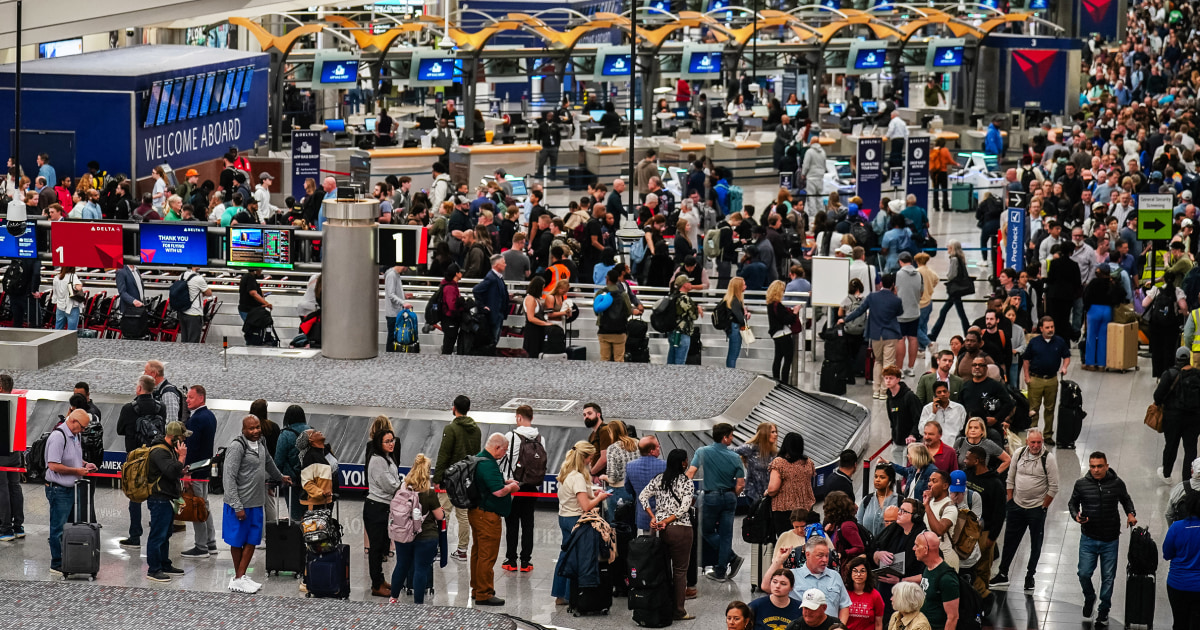
Democrats also expect that they will still ask for additional concessions after seeing the concrete GOP proposal. While they are anxious to get DHS funding approved, with hourslong lines plaguing airports across the country and TSA workers quitting by the hundreds, they are still asking for specific restrictions from the administration on ICE operations before voting yes on any proposal.
Britt, who chairs the appropriations subcommittee responsible for writing bills to fund DHS, was seen Monday talking on the Senate floor with Senate Minority Leader Chuck Schumer, D-N.Y., and the top Democrat on the Appropriations Committee, Sen. Patty Murray, D-Wash.
As she left the Capitol late Monday, Britt said she’d be “working through the night” to try to “land this plane.”
Sen. Mike Lee, R-Utah, the chief sponsor of the SAVE America Act, warned that the bill as written is ineligible for the reconciliation process.
“It’s hard to imagine how the SAVE America Act could be passed through reconciliation,” Lee wrote Tuesday on X. “And by ‘hard’ I mean ‘essentially impossible.’”
If attempted, it would be an arduous process that is subject to unlimited amendments by Democrats, who could seek to force politically uncomfortable votes on Republicans facing voters in the fall elections, when control of the Senate is up for grabs.
Sen. Susan Collins, R-Maine, said Tuesday she has reservations about attempting to pass elements of the SAVE America Act, a bill that she has otherwise endorsed.
“I don’t think that’s a good approach,” she said.