
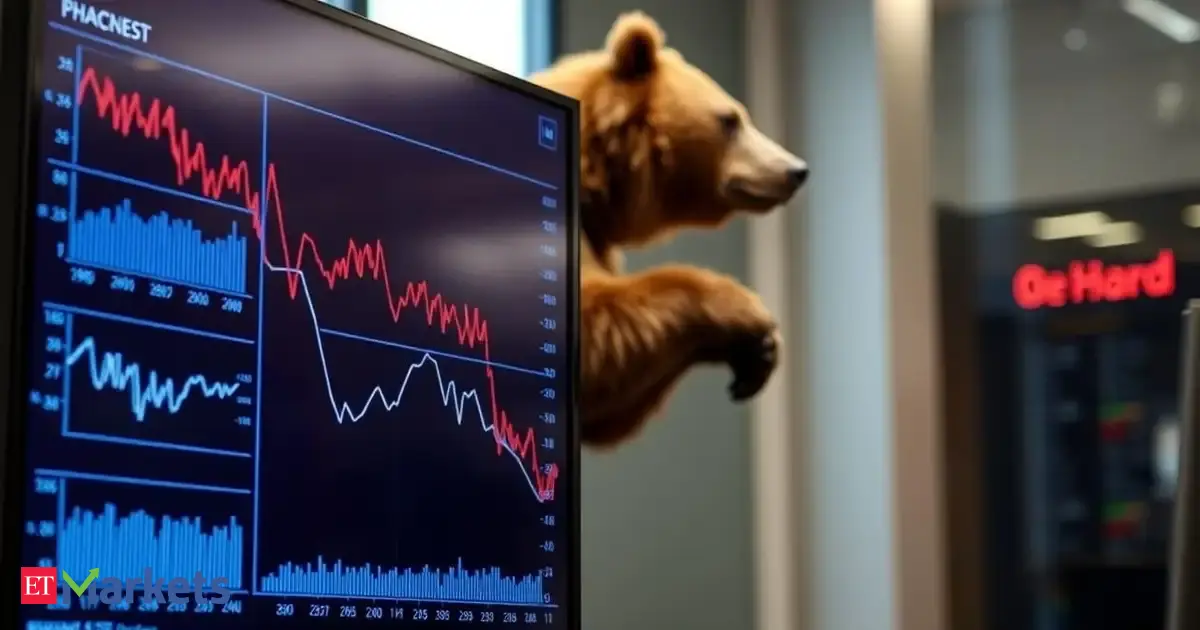
The Sensex has plunged 3,330 points in the brutal selloff, raising questions about whether this is merely a correction or the start of a full-blown bear market.
The carnage has been broad-based and merciless. PSU banks, tourism and airline stocks, real estate, banking and auto sectors have led the decline as escalating Middle Eastern tensions disrupted key oil and gas supplies, driving crude prices higher and threatening India’s fragile twin deficits. Defence stocks emerged as the only major winners, with Mazagon Dock, Solar Industries and Paras Defence surging amid the war.
“Persistent FII outflows reflect a broader de-risking strategy as geopolitical tensions in the Middle East and a surge in Brent crude toward $93 weigh heavily on emerging market sentiment,” said Vinit Bolinjkar, Head of Research at Ventura Securities.
The pain runs deeper than headline indices suggest. Around 80% of listed stocks with a market capitalization of at least Rs 1,000 crore have already fallen 20% from their all-time highs, technically a bear market in the broader market even as the Nifty is down only 7% from its peak.
Also Read | Iran war shock for Nifty bulls: How to tweak your portfolio for peace of mind
Technical indicators are flashing red across the board. The market is trading well below short-term and medium-term averages and is forming a lower top on daily charts. A bearish candle on weekly charts is also indicating further weakness from current levels.
Bolinjkar warned that the short-term outlook remains cautious due to rupee volatility and inflationary crude spikes. He expects high volatility to persist, favoring domestically-insulated sectors like capital goods and consumer durables, while globally-exposed pockets may face continued headwinds until macro-uncertainty subsides.
However, he noted that the structural narrative remains intact due to the “DII cushion”, domestic institutions bolstered by unwavering SIP inflows have absorbed selling pressure and prevented a deeper breakdown below the critical 24,300 Nifty support level.
Vinod Nair, Head of Research at Geojit Investments, painted an equally grim picture. “A sustained rise in oil prices could weigh on investor sentiment and adversely affect India’s twin deficits, inflation trajectory, and the RBI’s monetary stance. An uptick in U.S. 10-year bond yield and a stronger dollar have prompted FIIs to adopt a risk-off approach toward domestic equities,” he said, though he noted that “selective value-buying opportunities are expected to emerge, offering long-term investors attractive entry points.”
The question on every investor’s mind: is this the beginning of a prolonged downturn or a buying opportunity?
Also Read | 80% of Indian stocks are in bear market. Is it time to be greedy or fearful?
Fund managers are divided. Vinay Paharia, CIO at PGIM India Mutual Fund, acknowledged the crosscurrents. “At this juncture, we are seeing a mix of positives and a slew of uncertainties,” he said, pointing to healthy GDP prints, prospective trade deals, low interest rates and indirect tax cuts as positives, while flagging “global geopolitical uncertainty and its consequent impact on trade routes, rising crude and possibly other commodity prices, and AI-related disruption across sectors.”
Paharia warned that “many of the geopolitics-related impacts could be transitory in nature, while AI-related impacts are more long-term and would necessitate changes in business models, faster pivots, and greater agility by impacted companies and not all may be able to adapt.” He urged investors to “look through short-term volatility and focus on areas of self-sustaining growth.”
ArunaGiri N, Founder CEO & Fund Manager at TrustLine Holdings, struck a more opportunistic tone. “Historically, such phases are painful, but they are also when long-term opportunity quietly begins to build,” he said. “At the same time, it may be unwise to expect an immediate recovery. It may linger for a while. The prudent thing to do in such a sell-off is to grab the opportunities when the valuation is attractive instead of trying to time the bottom.”
ASK Investment Managers maintained that while rising trade and geopolitical uncertainty is expected to keep markets volatile, the investment case for India remains strong. “The relative macro stability, improving trade competitiveness and earnings recovery put India on a strong footing.”
The asset manager recommended a decisive tilt toward large caps, where valuations are relatively attractive and earnings visibility remains strong, complemented by selective exposure to micro-caps for investors with a long-term horizon of 5–7 years, given their illiquidity and higher risk. The firm stressed that “disciplined stock selection—focused on high-quality businesses and a concentrated approach—will be the key driver of outperformance as markets become increasingly selective and dispersion in returns widens.”
As geopolitical tensions simmer and oil prices threaten to spike further, Indian markets appear to be entering what Bolinjkar calls a phase of “rational consolidation”, a period where the DII cushion may prevent capitulation, but where volatility and sector rotation will separate winners from losers. Whether this consolidation morphs into a deeper bear market depends largely on factors beyond India’s control: the trajectory of the Iran conflict, crude oil’s next move, and global risk appetite.
For now, the bulls are nursing heavy wounds, and the bears are circling.