
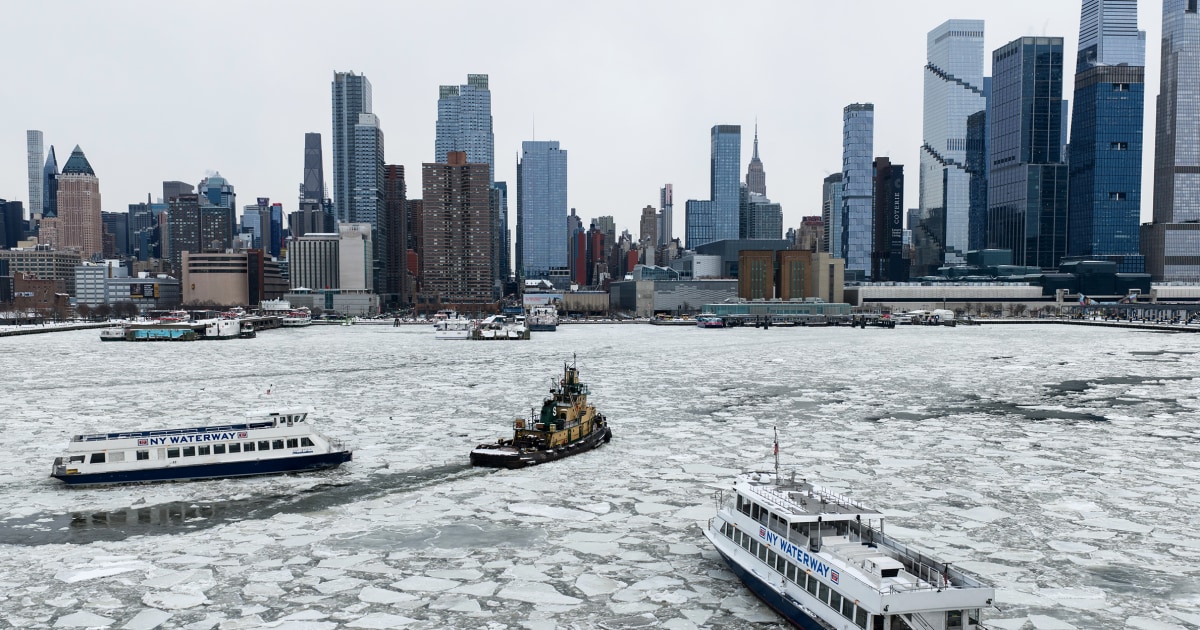
Dayslong deep freeze
A deep low-pressure system formed over eastern Canada and was ushering Arctic air straight into the Northeast and the midsection of the U.S.
The cold air will hang over the Northeast and the mid-Atlantic for the next couple of days, with wind chills below zero in many areas.
Temperatures in the teens and 20s that are forecast for the rest of the week are 15 to 25 degrees below average.
Another low-pressure system will affect the Southeast on Friday and Saturday, bringing wind chills well below what some areas of the South is used to by Sunday. Miami could dip below 40 degrees for the first time in more than a decade.
This blast of air will be even colder than what the U.S. is experiencing Wednesday, with approximately 80 record lows possible from Friday morning to Monday morning.
The National Weather Service said this period of frigid temperatures “could be the longest duration of cold in several decades.”
Potential winter storm this weekend
Another “significant” winter storm could hit the eastern U.S. this weekend, the weather service said. The agency noted its “confidence in coastal impacts has increased.”
The storm might bring wintry impacts to the East Coast from Friday night through Sunday night. Confidence in this forecast for the Carolinas and southern Virginia is increasing, but high uncertainty remains for the Northeast.
In one scenario, the storm could stay far enough off the coast that the highest snow risk remains in the eastern Carolinas, southern Virginia and southern New England, while keeping the area from Washington, D.C., to Connecticut without snow.
But if the storm tracks closer to the coast, snowfall would hit the mid-Atlantic and the Northeast.
It’s still too early to nail down the storm’s path and make a concrete prediction about how much snow will fall and where.
New York City’s Office of Emergency Management said Wednesday there was currently a 30% to 50% chance of snow for the area, but cautioned that forecasts would become clearer in the coming days. Still, the office urged residents to think ahead.
“New Yorkers should take time now to review their winter preparedness plans, check supplies, plan ahead for travel, and be ready to adjust schedules if conditions worsen,” the office said in a post on X.


Doha Madani and Steve Strouss contributed.