


It may not sound like a New Year’s resolution, but Dr. Ezekiel Emanuel is serving up some unusual advice as you start out 2026: Eat your ice cream. “Ice cream will make you happy, and that’s very important,” he explained.
I asked, “Why would I live longer eating ice cream?”
“Ice cream is a good dairy product; it’s got protein, its saturated fats are in a globule, so it doesn’t affect you as much as saturated fats in meats and other things,” he said. “Plus, you typically do it socially with someone else. And you know, being happy is a very important part of living a long time.”
“I feel like your saying ‘eat your ice cream’ is like ‘Don’t stress out as much about life. Be more social,'” I said.
“We’re here for only 75, 85, 90 years. You’ve got to make life enjoyable. You’ve got to make it fulfilling,” he said.
CBS News
The prominent oncologist and health policy expert is taking a different approach in his new wellness book, called, “Eat Your Ice Cream: Six Simple Rules For a Long and Healthy Life” (to be published Tuesday by W.W. Norton & Co.). He said, “I want people to stop obsessing. make it part of your life. You should like exercising, you should like eating well. Otherwise, you’re not going to do it for years and years and decades, which is what’s necessary for a long, healthy life.”
W.W. Norton & Co. 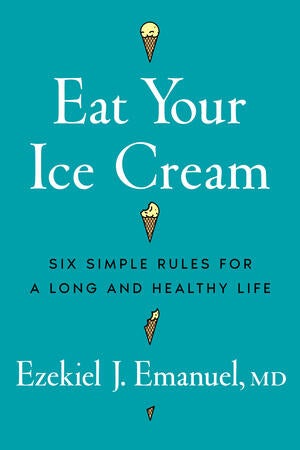
The doctor’s health handbook does include the basics of what to eat, how to exercise, and the all-important reminder that sleep is fundamental to wellness. But it goes beyond that, with behaviors that include “Don’t be a schmuck.”
“One of the things that is I think core to the book is, stop doing things that aren’t good for your health,” Emanuel said. “‘Don’t be a schmuck’ is my father’s reference to us when we were being stupid. And so, there are lots of things that we do as human beings that can be schmucky: smoking, vaping, doing drugs, not taking your vaccines. I don’t agree with the current administration, and they’re dead wrong on this.”
Also on the so-called schmuck list: alcohol.
I asked, “This is what everybody wants to know about: the right amount of alcohol, or no alcohol?”
Emanuel said, “There has been a lot of research on alcohol, so here’s the way I distill it: The safest level is probably zero. There are some studies, and we should be clear, where it’s half a cup a day, three cups a week.”
“Nobody drinks a half a glass of wine,” I said.
“So, you drink every other day,” Emanuel said. “On the other hand, 60, 65% of the public drinks. You’re not going from 65% to zero. So, you have to give people reasonable advice. And the reasonable advice is, first of all, no binge drinking, that’s really bad for you. Don’t drink alone. That’s really bad for you. If you’re using alcohol as a lubricant for social interaction, which many people do, that’s probably good; you’re getting some benefit from the social interaction.”
Social interactions – a consistent theme for Emanuel – is something he learned at a young age, growing up with brother Ari, a super-agent in Hollywood, and his other brother Rahm, the former mayor of Chicago and ambassador, who may be running for president of the United States.
I asked, “What is it that your parents taught all of you that has led you, I mean, you’re all incredibly successful?”
“Now you’re gonna make me cry,” Emanuel said, “because every time I talk about my parents and our growing up, I tend to cry. They taught us how to be social and interact with people. They also taught us how to be responsible. One of the things my mom did in raising us is, you know, get out of the house and go occupy yourself. Rahm and I went to school, I was six in first grade, and he was in nursery school. I had to take him from school, walk two blocks across a busy street, get on a bus, pay the car fare, get off at the right spot. I learned a huge amount of responsibility, taking care of my brothers.
“The other thing I think they did, which was super-important for us, is we all slept in the same bedroom. We were a unit. Yes, we fought endlessly. And you know, I like to joke with people, we didn’t go to bed until there was blood, you know, because of all the fights. But we were also each other’s best friends.”
His takeaway: relationships matter.
Emanuel also lists lifestyle choices he considers “anti-wellness,” like chronic stress, a fast-food diet, social media, and dining alone.
“I think people would agree with all of those, with the exception of dining alone,” I said. “A lot of people go to a restaurant or get home from work, and dine alone.”
Emanuel said that should be an occasional thing: “Don’t make it every day. And you know, if you find yourself dining alone, what you should do is call up a friend. If you’re sitting at a bar, right, and you’re dining there, ask the person next to you, you know, ‘Have you been to this restaurant before? What do you do? Why are you here?’ Yeah, strike up a conversation. We underplay those casual conversations and how important they are for us.”
His book also discusses retirement: “Retirement leads to more rapid cognitive decline for people. I say to people, don’t retire. And if you’re gonna retire, you have to plan retirement well, so that you stay engaged, you stay mentally sharp. And that doesn’t mean, ‘Well, you know, I’m gonna try to play the saxophone one day.'”
“But Dr. Emanuel, a lot of retired people like to buy books, and watch ‘Sunday Morning,'” I said.
“Well, if they’re buying books and staying mentally engaged that way, if they’re going to volunteer, say, or they’re talking to friends, or they’re taking up a new hobby seriously, all of that is excellent, highly endorsed,” he replied.
“Meaning don’t retire the mind, or retire your social engagement?”
“Yes, and it’s very important, you’ve got to be deliberate about it. You can’t let nature take its course.”
So, what is his biggest piece of advice for us in 2026? “Build your social relationships,” he said. “It’s definitely the most important thing for long-lasting health and happiness.”
READ AN EXCERPT: “Eat Your Ice Cream” by Ezekiel J. Emanuel, M.D.
WEB EXCLUSIVE: Extended interview – Dr. Ezekiel Emanuel (Video)
For more info:
Story produced by Julie Morse. Editor: Lauren Barnello.