

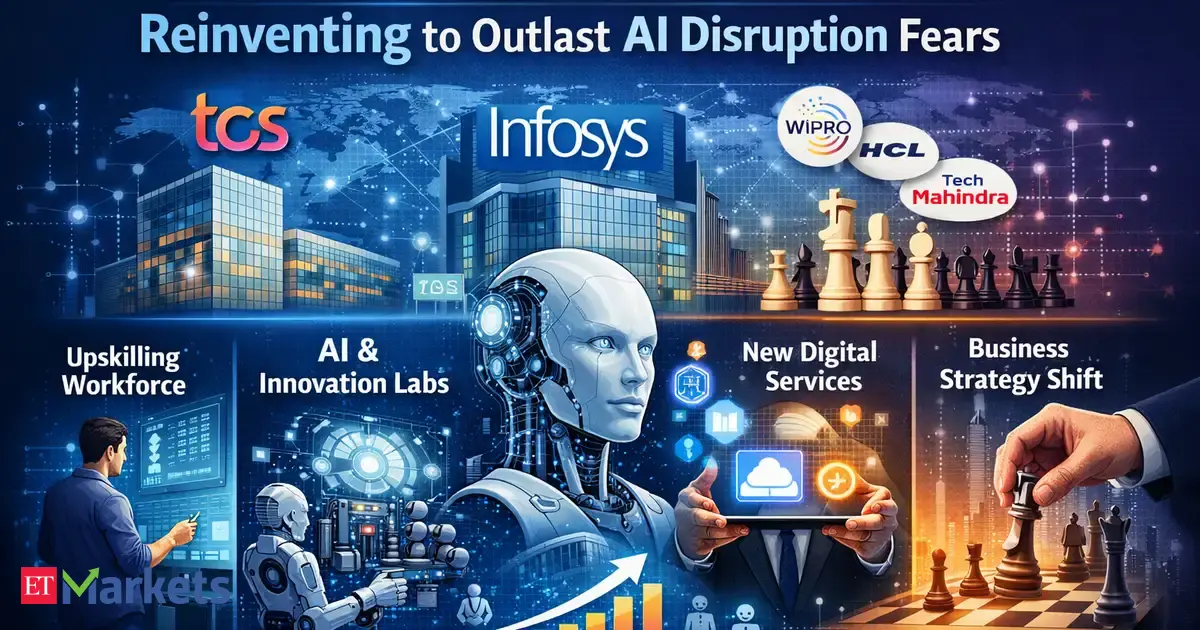
Yet beyond the headlines, not everything is doom and gloom. The country’s largest software exporters are trying hard to convince clients and investors that AI won’t “delete” the services model and are already rolling out plans to adapt to an uncertain future. Whether this proves too little, too late or simply not enough against the massive spending by US tech giants on frontier AI, is a debate that will play out over time.
A recent JP Morgan sector note framed the current AI discourse as “discounted for extinction” but argued AI will also create net new areas of work — from addressing multi-decade tech debt and modernising legacy code, to rewriting custom versions of SaaS where enterprises need more control, to building AI trust, reliability and operational services.
The bank also noted that enterprise tech teams remain under-resourced versus business demands, which could keep a role for large services firms even in an AI-heavy world.
HSBC, in a separate research note on software, took a different but complementary view. The AI versus software debate is often flawed because AI typically needs to sit inside enterprise software and day-to-day workflows.
“In large organisations, AI is unlikely to run as a standalone “magic box”. It usually has to work with data systems, access permissions, audit checks and risk controls, areas where large IT vendors and enterprise platforms still matter,” the brokerage said.
The market, however, needs an answer to a different question. Even if the work doesn’t disappear, does AI reduce the money IT companies can make by sharply cutting the hours and people needed to deliver it?Motilal Oswal estimates 30-40% of IT services revenue is at risk from AI-led deflation concentrated in app development, maintenance and testing. If AI lifts productivity by 30-50% in those areas, Motilal argues 9-12% of sector revenue could be eliminated over three to four years, effectively a 2% hit to annual growth during the transition.
The brokerage warns the risk could rise further if AI also compresses ERP migration and third-party enterprise software work, which it pegs at another 10-15% of industry revenues.
JP Morgan tried to quantify what is already priced into the big stocks. The brokerage worked backwards from current share prices to infer what growth the market is assuming. It said current prices for TCS, Infosys and HCL Tech imply roughly 4%, 4% and 5.6% 10-year revenue CAGR, which is below the long-term average the sector once enjoyed.
Its “uber-bear” scenario, where growth falls to 0% in perpetuity due to AI disruption, implies potential downside of more than 30% for the three names. The flip side is that if growth improves even slightly from today’s “low single digit” reality, valuations may not be as stretched as the market action suggests, meaning a meaningful chunk of pessimism is already baked in.
So what are the companies doing, in practical terms, to bend the outcome in their favour?
The biggest internal shift is how India’s tech giants are changing the way they deliver work. All large firms are using coding assistants and automation across the software lifecycle — coding, testing, documentation, migration assessment, and even support functions like handling incidents and alerts.
Sandeep Gogia, sector lead for tech and digital at Equirus Capital, said the big vendors are already using tools such as GitHub Copilot and similar assistants, while training engineers to work alongside AI-led agents.
“They’re training their manpower on AI tools and AI-assisted coding, and learning to work with AI agents, either their own or through partners,” he said. The internal goal is to take the cost out, reduce turnaround time, and protect margins even as clients push for more output at the same or lower spend.
The second shift is what they are selling. Instead of pitching AI as a lab experiment, firms are trying to embed AI into large transformation programmes, setting up cleaner data layers, modernising old applications, moving systems to cloud, and then helping clients use their own data safely with AI.
That also includes building guardrails around security, privacy and compliance, because enterprises are unlikely to deploy AI widely if they fear data leaks or regulatory blowback.
Gogia says this is where large systems integrators still have an edge. “This requires contextual knowledge, business logic and clarity about industry rules and regulations,” he said. “That knowledge repository is more with large IT services firms.”
The third shift is partner strategy. While the big model makers and cloud providers control the chips, computing power and foundation models, several analysts said Indian IT firms are trying to control everything around it, which is implementation, integration, change management, and the long-term running of AI systems inside a client’s business.
Vinit Bolinjkar, head of research at Ventura, calls this a move away from pure “people-led” growth. “The transition is from a headcount-led model to an outcome-led, IP-led model,” he said.
He added that AI is already showing up in deal conversations and deal wins, even as companies acknowledge a reality investors are anxious about, where they see higher productivity will squeeze some older revenue pools such as traditional application maintenance.
Against that backdrop, how is AI posturing looking for the big four — TCS, Infosys, HCL Tech and Wipro?
TCS: Scale, infrastructure and ‘full-stack’ ambition
TCS is leaning into scale and execution resilience, but it is also signalling it wants to be more than just a services layer. The company has talked about building “full stack” capability — from infrastructure to AI-led solutions — so it can offer end-to-end delivery.
It has announced a strategic investment in a 1 GW capacity AI data centre in India to support “sovereign AI” requirements, a theme that is gaining traction as enterprises and governments worry about where data sits and who controls it.
TCS has also trained over 350,000 employees in GenAI foundational skills and held a large internal AI hackathon to push an “AI-first” culture.
Bolinjkar said TCS looks strongest on “AI monetisation scale” and financial durability, citing an annualised AI revenue run-rate of about $1.8 billion. Analysts bet is that TCS can absorb pricing pressure better than peers because of its breadth and ability to industrialise delivery.
Abhinav Tiwari, research analyst at Bonanza, also sees TCS as a steadier name in this transition. “TCS looks defensively strong,” he said. However, he added that “much of its AI is embedded rather than sold as a standalone product line,” which means the AI benefit may show up more in win rates and delivery efficiency than in clean, separate AI revenue disclosures.
TCS has also been highlighting deal momentum where AI plays a central role, including large multi-year contracts where automation and optimisation are part of the value pitch.
Infosys: Topaz, agents and a more product-like story
Infosys is pushing a more structured, productised AI narrative through its Topaz platform and an agent-based approach. It has said Topaz is increasingly being embedded in new large deals, and it has also talked about building more than 100 GenAI agents for client workflows, tools that can automate specific tasks within business processes.
The company’s strategy, as described by analysts, is to look less like a pure staffing engine and more like an enterprise AI partner that brings reusable components, frameworks and industry playbooks.
“Tiwari called Infosys’ approach more IP-led. “Infosys has the most productised AI story through Topaz,” he said. “It is clearly linking AI to large deal wins and margin improvement.”
Infosys has also pointed to strong large-deal momentum, with AI now featuring in a growing share of client conversations, and has highlighted its ability to fund capability-building through strong cash flows.
HCL Tech: Engineering-heavy AI and infrastructure intensity
HCL Tech is aiming to differentiate through engineering and infrastructure-heavy AI use cases—areas where AI meets networks, cloud infrastructure, industrial systems and the broader “build and run” stack.
Bolinjkar said this positioning could work well in deployments where engineering depth matters. “In an AI world, enterprises don’t just need models,” he said. “They need resilient systems, security, and integrations across messy environments.”
HCL has been pushing its AI Force platform as a way to automate parts of the software development lifecycle — coding, testing and documentation – and has cited meaningful productivity improvements for clients using such tools. It has also expanded capabilities through targeted moves in specific verticals, including telecom.
Wipro: Big spending, training push, but still a turnaround narrative
Wipro remains the one analysts still treat as a turnaround. It has committed $1 billion over three years to advance AI, data and analytics, and has trained a large part of its workforce on AI skills. It has also positioned ai360 and its Lab45 innovation unit as engines to bring AI into client work, alongside a pipeline of investments through Wipro Ventures in early-stage AI startups.
But its growth has lagged peers, and its AI monetisation metrics are less visible. “Wipro remains more of a turnaround bet,” Tiwari said, while adding that TCS, Infosys and HCL Tech look like safer long-term beneficiaries “based on current evidence” and execution track records.
The deeper debate is not whether AI will be used, but who is better placed to capture the economics, according to several analysts that ETMarkets spoke to. If AI reduces effort, clients will demand lower prices. That can hit revenue even if the number of projects rises. To offset this, IT vendors are trying to move up the value chain, where they are charging more for outcomes, platforms, managed AI operations, and risk controls, while using AI internally to preserve margins.
For investors, key things to watch out is the management commentary around whether AI is actually supporting large deal wins. This can be already be seen from several statements from the recent third quarter.
(Disclaimer: Recommendations, suggestions, views and opinions given by the experts are their own. These do not represent the views of Economic Times)