
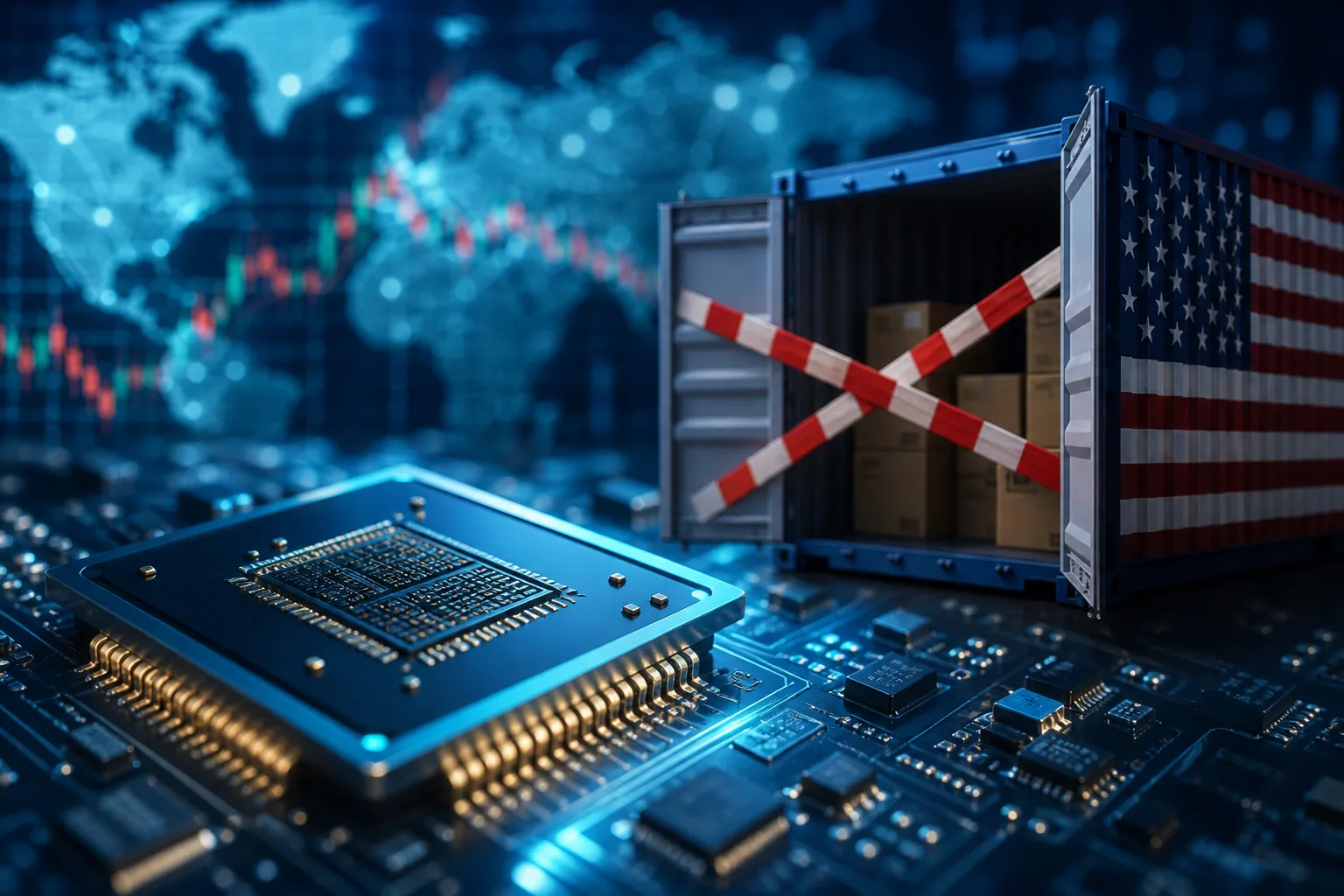
For investors in semiconductor stocks, export controls have become more than a geopolitical headline. They are now a core business risk that can affect revenue visibility, product design, customer access and valuation multiples across the chip sector. The most important issue is not simply whether a company can sell to China today, but how quickly the rules may change tomorrow.
The United States has tightened restrictions on advanced computing chips, AI accelerators and chipmaking equipment sold to China, with a particular focus on technologies that could support artificial intelligence, supercomputing and military applications. That has created a new operating environment for chip stocks: demand remains strong in many end markets, especially AI infrastructure, but the addressable market for the most advanced products is increasingly shaped by policy.
Why export controls matter for chip investors
Semiconductor companies are global by design. A chip may be designed in the United States, manufactured in Taiwan or South Korea, packaged in Southeast Asia, and sold to customers in China, Europe or the cloud-computing market. Export controls interrupt that model by placing limits on where certain high-performance chips, design tools or manufacturing equipment can go.
For investors, the impact can show up in several ways:
- Revenue uncertainty: Companies with meaningful China exposure may face sudden changes in demand if products become restricted or require licenses.
- Product redesign costs: Some firms may create lower-performance versions of chips to comply with rules, but future restrictions can still narrow that path.
- Customer delays: Buyers may postpone orders if they are unsure whether shipments will be approved.
- Margin pressure: Compliance, redesign, inventory management and supply-chain changes can add costs.
- Valuation risk: Markets may apply lower multiples to companies perceived as exposed to political risk, even if current earnings remain strong.
AI chip exports are the center of the reset
The biggest flashpoint is the export of advanced AI chips. Demand for graphics processors and AI accelerators has surged as cloud providers, internet platforms and enterprises build systems for generative AI, recommendation engines, data analytics and scientific computing. That demand has been a major driver for leading chip companies and a key reason semiconductor stocks have attracted investor attention.
However, AI chip exports to China sit directly in the path of U.S. policy. Washington’s concern is that the same hardware used to train commercial AI models can also strengthen strategic and military capabilities. As a result, the rules tend to focus on performance thresholds, interconnect speeds and other technical features that determine whether a chip falls inside a restricted category.
This creates a moving target for companies. A product designed to comply with one version of the rules may become less attractive commercially, or may later be affected by revised standards. That is especially relevant for leading AI suppliers and Nvidia rivals trying to gain share in accelerators, networking chips, memory and custom silicon.
Winners and losers may not be obvious
It is tempting to assume export controls are automatically negative for all chip stocks, but the picture is more complicated. Companies with heavy exposure to restricted AI products and China-based customers face clearer risk. But firms focused on automotive chips, industrial semiconductors, power management, analog chips or less advanced consumer components may be less directly affected.
Chip-equipment makers are another important category. Restrictions on advanced manufacturing tools can limit sales to Chinese fabs, but they may also reinforce demand from foundries and governments investing in production capacity outside China. The result is a sector where company-specific analysis matters more than broad labels.
Investors should also watch domestic Chinese competition. Export controls may encourage China to accelerate its own semiconductor ecosystem, including design, fabrication, packaging and equipment. That could take years and may face significant technical hurdles, but it can still reshape competitive dynamics over time.
Key questions for evaluating semiconductor stocks
When reviewing earnings reports or management commentary, investors should look beyond headline AI demand and ask practical questions about exposure and flexibility:
- How much revenue depends on China or China-based customers? Companies often discuss geographic exposure, though it may not perfectly reflect end demand.
- Are the most important products subject to export licenses? Restricted products can create shipment uncertainty even when demand is strong.
- Can the company redirect supply? Firms with broad customer bases in the U.S., Europe, Japan, South Korea, Taiwan and other markets may be more resilient.
- Does the business rely on one product cycle? Concentration in a narrow AI chip segment can increase both upside and policy risk.
- What is management saying about compliance? Clear disclosure and conservative planning are preferable to vague assurances.
Tech stock risks extend beyond regulation
Export controls are not the only risk facing semiconductor investors. The sector is cyclical, capital-intensive and highly sensitive to inventory swings. AI spending could remain strong, but expectations are already high for many companies linked to data-center growth. If customers slow capital spending, shift to in-house chips or optimize existing infrastructure, market sentiment can change quickly.
There is also supply-chain risk. Advanced chips depend on a small group of critical manufacturing partners, packaging providers, memory suppliers and equipment vendors. Any disruption in one part of the chain can affect delivery schedules and margins across the industry.
For long-term investors, the export-control reset does not eliminate the semiconductor growth story. Chips remain central to AI, cloud computing, electric vehicles, automation, defense systems and consumer devices. But it does mean the sector should be analyzed through both a technology lens and a policy lens.
The practical takeaway: avoid treating semiconductor stocks as a single trade. Separate companies by product category, customer exposure, manufacturing dependence and regulatory sensitivity. In a market where AI demand and China export controls are pulling in opposite directions, selectivity may matter as much as growth.