
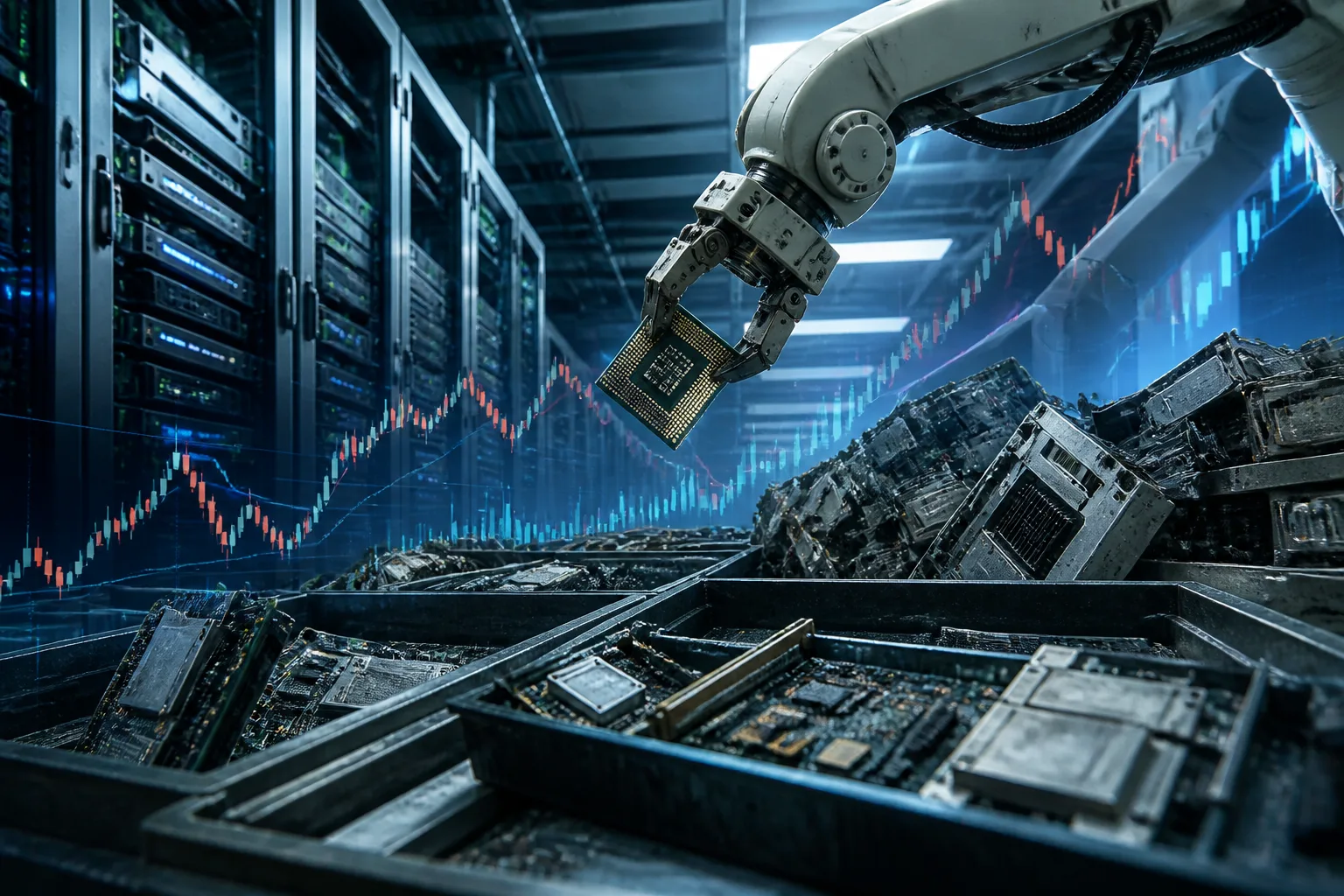
AI capex has become one of the defining themes in U.S. markets, powering optimism around semiconductors, cloud computing, data centers and the Magnificent Seven. But the spending boom has a quieter second act: depreciation expense. As companies pour capital into chips, servers, networking gear and facilities, those costs do not disappear. They move gradually through the income statement, creating a potential earnings risk that investors may be underestimating.
For now, markets have largely rewarded companies seen as AI infrastructure winners. Strong demand for advanced chips, cloud capacity and enterprise AI tools has helped support premium valuations across parts of the tech sector. The question is whether future revenue growth will be large and durable enough to absorb the rising cost base that today’s capital spending creates.
Why depreciation matters more in the AI buildout
Capital expenditure is not recorded as an immediate operating expense. When a company builds a data center or buys servers, the asset is placed on the balance sheet and expensed over time through depreciation. That accounting treatment can make near-term profitability look resilient even while cash outflows rise sharply.
In an AI infrastructure cycle, depreciation can become especially important because the assets are expensive, specialized and may have uncertain useful lives. Graphics processors, accelerators and related hardware can become outdated quickly if newer chips offer better performance or energy efficiency. If equipment needs to be replaced sooner than expected, companies may face higher depreciation charges, impairment risk or weaker returns on invested capital.
This does not mean AI spending is irrational. Large technology companies are investing to defend existing businesses, expand cloud computing platforms and capture new demand from software developers, enterprises and consumers. But the accounting lag matters. A company can report strong earnings today while building a depreciation burden that weighs on margins later.
The market risk: earnings expectations may be too smooth
Many tech stocks trade on expectations that AI will support years of revenue growth. That may prove true for some companies. The risk is that investors extrapolate demand while giving less attention to the cost required to serve it. If AI revenue ramps more slowly than expected, depreciation expense can pressure operating income even when sales continue to grow.
This is particularly relevant for companies operating large cloud platforms. Cloud computing is capital intensive by nature: providers must build capacity before customers fully use it. AI makes that challenge more complex because high-performance computing clusters require advanced chips, power, cooling and networking. Utilization rates matter. Idle or underused capacity still depreciates.
For investors, the issue is not simply whether AI demand exists. It is whether that demand produces attractive returns after accounting for the full cost of infrastructure. A cloud provider may generate impressive AI-related revenue but still disappoint shareholders if margins compress or free cash flow weakens.
What to watch in tech earnings reports
Investors do not need to become accounting specialists, but they should pay closer attention to a few signals in quarterly reports and management commentary:
- Capital expenditure trends: Rising capex can be positive if it supports profitable growth, but investors should compare spending plans with revenue visibility and margin guidance.
- Depreciation expense: Watch whether depreciation is growing faster than revenue or operating income. That can indicate pressure building beneath headline results.
- Useful life assumptions: Changes in estimated asset lives can affect reported earnings. Shorter useful lives increase depreciation expense, while longer lives can delay it.
- Cloud margins: Segment margins can reveal whether AI workloads are improving profitability or merely increasing scale.
- Free cash flow: Earnings may look strong even when heavy infrastructure spending reduces cash generation.
Management language also matters. Phrases about “capacity constraints” may signal strong demand, while comments about “optimizing infrastructure,” “matching supply with demand” or “improving utilization” can suggest that the spending cycle is becoming more delicate.
Why the Magnificent Seven are central to the debate
The Magnificent Seven have an outsized influence on major U.S. equity indexes, and several of these companies are central to the AI capex cycle. Some are spending heavily on data centers and chips. Others benefit by selling hardware, software or cloud services into that buildout. Because these companies carry large index weights, any shift in earnings expectations can affect the broader market, not just individual tech stocks.
The group is not uniform. A chip designer faces different risks than a cloud platform, an advertising-driven platform or a consumer hardware company. Still, the market has often treated AI exposure as a broad positive. Over time, investors may become more selective, rewarding companies that can convert AI investment into durable revenue, pricing power and cash flow while penalizing those with weaker returns.
A more disciplined way to view AI capex
The AI investment cycle may continue for years, but it should not be analyzed only through revenue growth or product announcements. Depreciation expense is where ambitious spending meets accounting reality. It can turn today’s infrastructure race into tomorrow’s margin challenge.
For long-term investors, the key is not to avoid AI-related companies altogether. It is to distinguish between productive capex and defensive overspending. Productive capex creates assets that customers use at profitable rates. Defensive capex protects market position but may deliver lower returns. The difference will become clearer as depreciation rises and AI services mature.
In a market where tech stocks drive much of the index narrative, AI capex is no longer just a growth story. It is also a cost story, a cash flow story and potentially an earnings risk. The companies that manage all three well are likely to justify investor confidence. Those that do not may find that the most important AI expense was simply delayed, not avoided.