

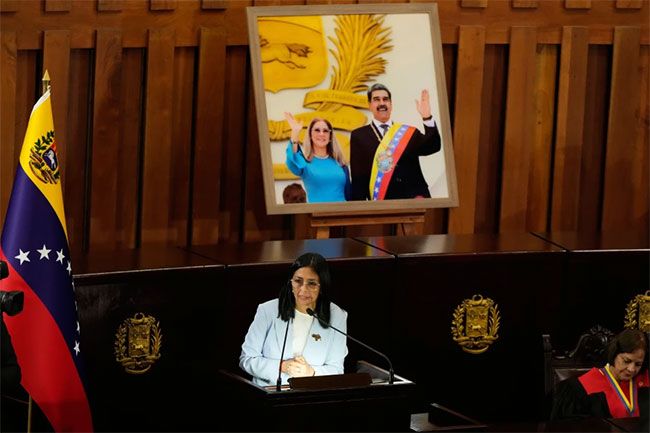
Venezuela’s acting President Delcy Rodríguez on Friday announced an amnesty bill that could lead to the release of hundreds of prisoners, including opposition leaders, journalists and human rights activists detained for political reasons.
The measure had long been sought by the United States-backed opposition. It is the latest concession Rodríguez has made since taking the reins of the country on Jan. 3 after the brazen seizure of then-President Nicolás Maduro in a U.S. military attack in Venezuela’s capital, Caracas.
Rodríguez told a gathering of justices, magistrates and others that the ruling party-controlled National Assembly would take up the bill with urgency.
“May this law serve to heal the wounds left by the political confrontation,” she added during the televised event.
Rodríguez also announced the shutdown of Helicoide, a prison in Caracas where torture and other human rights abuses have been repeatedly documented by independent organizations. The facility, she said, will be transformed into a sports, social and cultural center for police and surrounding neighborhoods.
The Venezuelan-based prisoners’ rights group Foro Penal estimates that 711 people are in detention facilities across the South American country for their political activities.
The government did not release the text of the bill on Friday, leaving unclear the specific criteria that will be used to determine who qualifies for amnesty.
Rodríguez said the “general amnesty law” will cover the “entire period of political violence from 1999 to the present.” She also explained that people convicted of murder, drug trafficking, corruption or human rights violations will not qualify for relief.
Rodríguez’s government earlier this month had announced plans to release a significant number of prisoners in a goodwill gesture, but relatives of those detained have condemned the slow pace of the releases.
“A general amnesty is welcome as long as its elements and conditions include all of civil society, without discrimination, that it does not become a cloak of impunity, and that it contributes to dismantling the repressive apparatus of political persecution,” Alfredo Romero, president of Foro Penal, said on social media.
The organization has tallied 302 releases since Jan. 8, when National Assembly president Jorge Rodríguez announced that the government would free a significant number of prisoners.
The human rights group Provea in a statement called out the lack of transparency and “trickle” pace of prisoner releases over the past few weeks and underscored that while the freeing of those still detained “is urgent, the announcement of an amnesty should not be conceived, under any circumstances, as a pardon or act of clemency on the part of the State.”
“We recall that these people were arbitrarily imprisoned for exercising rights protected by international human rights instruments, the National Constitution, and Venezuelan laws,” the organization said.
Source: AP
–Agencies
Forrás: eredeti cikk