

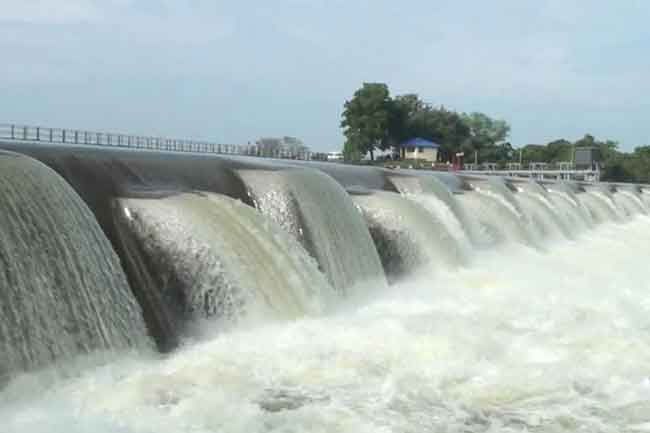
The Department of Irrigation stated that out of the 73 major reservoirs under its control, 36 reservoirs are currently spilling.
Director of Hydrology and Disaster Management at the Department of Irrigation, Engineer L.S. Sooriyabandara, said that nearly 52 medium-sized tanks are also spilling.
He emphasized that the ongoing spilling of reservoirs does not pose a flood risk, and therefore the public should not be unnecessarily alarmed.
However, he noted that river water levels could change depending on upcoming monsoon rainfall, and stressed the need for continued monitoring and necessary precautionary measures.
Meanwhile, the Department reported that the highest rainfall during the past 24 hours was recorded in areas associated with the Nilwala River basin.
Rainfall ranging between 50 and 100 millimetres was reported in several locations within the basin, while around 25 millimetres was recorded in many parts of the wet zone.
In addition, approximately 50 millimetres of rainfall was recorded in certain areas of the Central Highlands and the Kelani River basin. Rainfall between 25 and 50 millimetres was also reported in parts of the Eastern Province, the department said.
Sooriyabandara stated that although a slight increase in the water level of the Nilwala River has been observed, it has not reached flood-risk levels based on the rainfall received.
He further noted that the water level at Manampitiya along the Mahaweli River remains relatively high but is gradually decreasing.
Despite rainfall in other catchment areas, water levels have not risen to levels that would cause flooding, he added.
Forrás: eredeti cikk